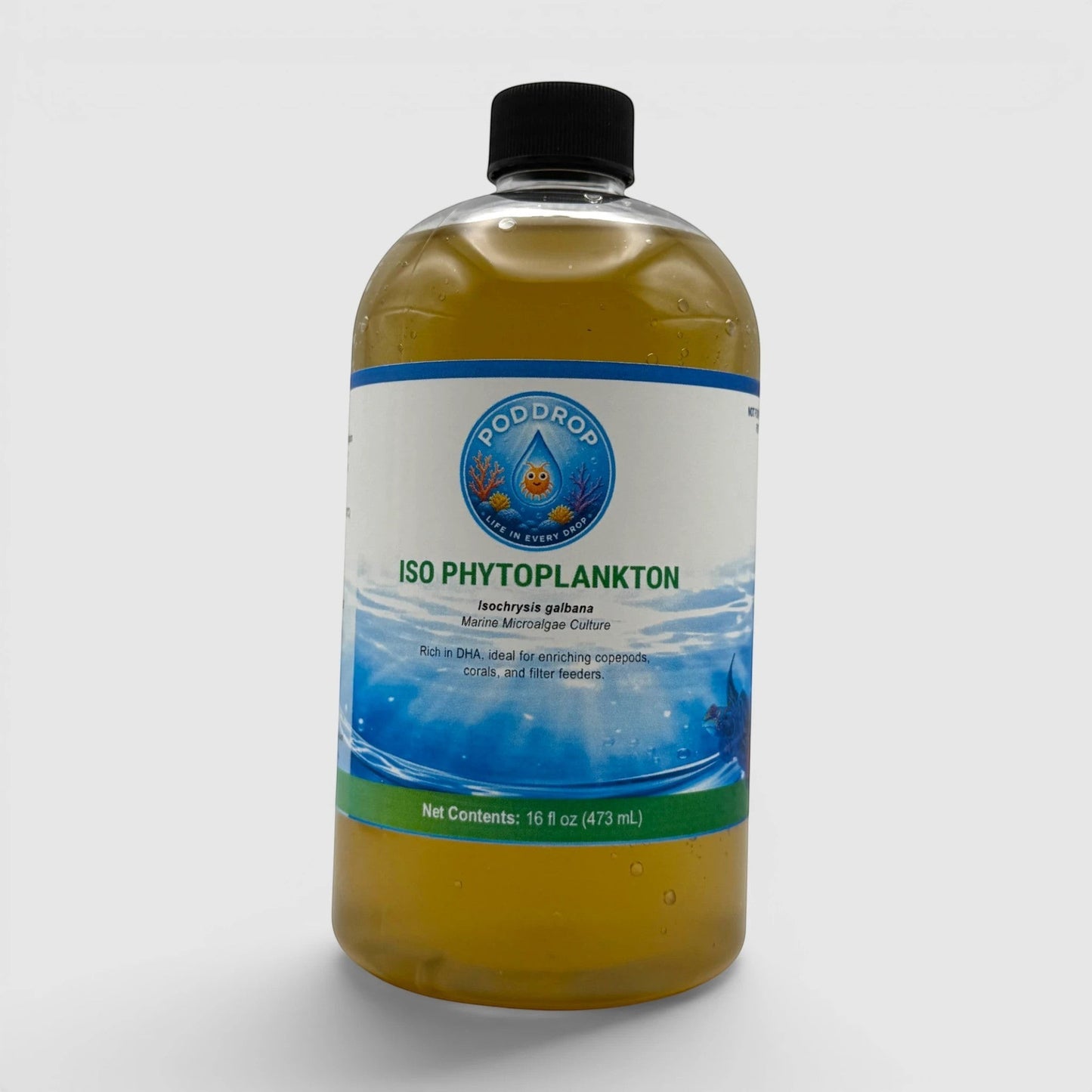
Live microalgae
A living microalgae culture intended for compatible aquarium feeding, live-feed production, or professional culture work.
$0.00 USD
Product appearance can vary naturally. Confirm the exact item and size in the product details.
3 viewsCULTURED IN ARIZONA • LICENSE AQ91
Couldn't load pickup availability
Product overview
Product Overview
The Phyto Fusion Pack is PodDrop's comprehensive three-species phytoplankton blend engineered to deliver the complete nutritional spectrum your reef demands. This strategic color combination pairs green Nannochloropsis (EPA powerhouse), golden Isochrysis galbana T-ISO (DHA specialist), and red Rhodomonas salina (color enhancer)—three complementary species with distinct cell sizes, fatty acid profiles, and pigment systems that together create complete reef nutrition impossible from single-species feeding.
Perfect for aquarists seeking maximum nutritional diversity without purchasing individual bottles, Phyto Fusion eliminates the guesswork of species selection through proven scientific pairing. The three-color formula ensures your reef receives the full omega-3 spectrum (EPA for immune function from Nannochloropsis, DHA for tissue growth from Isochrysis, both combined in Rhodomonas), complete pigment diversity for coral coloration (green chlorophylls, golden fucoxanthin, red phycoerythrin), and varied cell sizes (2-10 microns) that accommodate everything from tiny coral polyps to large clams. Each species feeds different organisms while enriching copepods with complementary nutrients—Nannochloropsis fuels copepod reproduction, Isochrysis drives coral growth, and Rhodomonas intensifies reds and oranges. The combination prevents nutritional deficiencies that develop from monotonous diets while providing biological redundancy across different water conditions. All three species arrive as living, actively dividing cultures ready to deliver comprehensive reef nutrition immediately upon addition. This is complete phytoplankton diversity in one convenient package.

WHY THIS CULTURE
Phytoplankton strains differ in cell size, motility, nutritional profile, culture requirements, and compatibility with target organisms. Select the strain for the job.
A living microalgae culture intended for compatible aquarium feeding, live-feed production, or professional culture work.
Relative cell size, motility, and strain characteristics influence which organisms and culture protocols a phytoplankton is best suited to support.
Compatible phytoplankton can support copepod and other live-feed culture routines and may also be used in appropriate aquarium feeding programs.
Culture requirements vary. Diatoms, flagellates, and green microalgae should not be assumed to share the same nutrient or handling needs.
The organism, relative scale, habitat, and intended application match the system you are planning.
You need a different prey size, habitat profile, microalgae type, or culture workflow.
CULTURE PROFILE
Use this profile as a fast biological check before moving into detailed handling, comparison, and research notes.
FROM BOTTLE TO SYSTEM
Live cultures are biological products. The most useful receiving and use guidance is specific to the organism and the role you expect it to perform.
WHAT’S INSIDE THE BOTTLE?
The bottle contains living microalgae in culture medium. Color and visual density vary by strain, concentration, lighting, growth phase, and handling; color alone is not a universal measure of cell count or quality.
WHERE IT FITS
Phytoplankton is selected by the organisms and culture processes it is intended to support.
Bring the shipment inside after delivery and inspect the package and culture condition.
Match the strain’s cell profile and culture characteristics to the copepod, rotifer, larva, filter feeder, or aquarium program you intend to support.
Use the product-specific directions and the requirements of the target organism or culture rather than relying on color or bottle size alone.
Follow product-specific temperature, light, aeration, sanitation, salinity, and nutrient guidance when propagating live microalgae.
UNDER THE MICROSCOPE
Phytoplankton cells are microscopic. Bottle color is useful context, but it is not a universal substitute for cell counts, microscopy, or strain-specific culture assessment.
Pigment and apparent density vary by species, concentration, growth phase, light path, and container.
Reveals cell morphology, relative cell size, motility where applicable, and culture condition at the sample level.
Use the strain profile and culture protocol together with visual observations when evaluating a live microalgae culture.
Use movement, life-stage expectations, and the species profile together. A live culture should not be judged only by what is obvious in the unopened bottle.
COMPARE THE PROFILE
Cell profile, motility, culture requirements, and target organisms matter more than bottle color alone. Use the matrix to select a strain by function.
| Profile | Nannochloropsis | Iso / T-ISO | Tetraselmis |
|---|---|---|---|
| Relative cell profile | Small | Small | Larger |
| Motility | Non-motile | Motile flagellate | Motile flagellate |
| Silicate | Not required | Not required | Not required |
| Strong use case | Live-feed culture support | Hatchery / enrichment | Live-feed / larger-cell diversity |
Know what you are adding
Product-specific metafields appear here when available, with practical fallback guidance for every item.
PodDrop’s Live Arrival Policy covers the condition of eligible live products at the carrier’s first delivery attempt. If a culture appears nonviable, materially leaking, missing, or incorrect because of a PodDrop packing or fulfillment error, contact PodDrop within 2 hours of the carrier’s recorded delivery time.
Keep the culture and all original packaging. Before adding, transferring, feeding, or discarding the product, provide your order number, delivery timestamp, a concise description, and clear photographs or video showing the culture in its original container, the shipping box and insulation, any damage or unusual condition, and the shipping label.
PodDrop reviews each report using the order record, carrier tracking, delivery conditions, packaging, documentation, and reported handling after delivery. If a claim is approved, PodDrop may provide a replacement of the affected item or store credit, depending on the circumstances and current product availability.
Coverage does not guarantee establishment, reproduction, continued survival, feeding response, aquarium performance, or compatibility after receipt. Read the complete Live Arrival Policy for eligibility requirements, exclusions, and submission instructions.
RECEIVING & TECHNICAL NOTES
Keep the purchasing experience simple at the top of the page, then make the deeper handling and technical information easy to find when a customer needs it.
Inspect the culture on arrival before adding, feeding, or discarding it. If there is an arrival concern, document the condition promptly under the published Live Arrival Policy.
Live Arrival Policy →Phytoplankton selection should account for strain identity, relative cell size, motility, target organism, salinity, nutrient regime, light, sanitation, and whether silicate is required.
Research & professional use →Add precision after the bundle
Use a targeted copepod to reinforce the habitat, prey profile, or culture objective that matters most after the starter system is established.
Shop single-species copepods →VERIFIED CUSTOMER FEEDBACK