Skip to product information
1 of 2

Product appearance can vary naturally. Confirm the exact item and size in the product details.

2 views

CULTURED IN ARIZONA • LICENSE AQ91

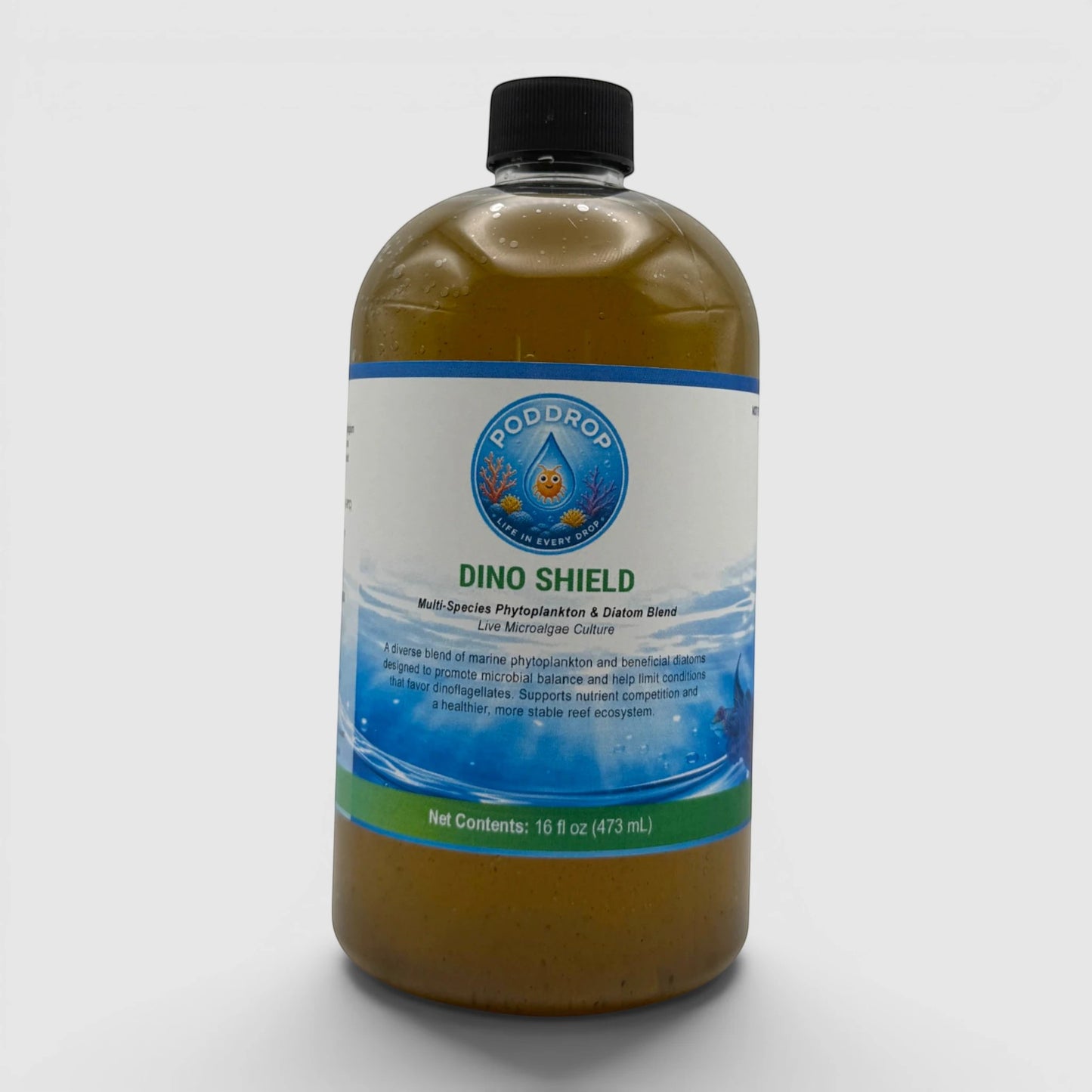
Dino Shield Phytoplankton Culture Blend

Dino Shield Phytoplankton Culture Blend

Regular price $28.00
Regular price Sale price $28.00
Sale Sold out
Shipping calculated at checkout.
LIVE CULTUREMULTI-STRAIN LIVE MICROALGAECULTURED BY PODDROP
Best for
Mixed reef feedingLive-feed culturesFilter feedersMicroalgae diversity
Size
Quantity
Auto-Ship & Save (Cancel Anytime)

Auto-renews, skip or cancel anytime.

Auto-Ship & Save (Cancel Anytime)

Auto-renews, skip or cancel anytime.

Auto-Ship & Save (Cancel Anytime)

Auto-renews, skip or cancel anytime.

To add to cart, go to the product page and select a purchase option

Product overview

Product Overview

Dino Shield is a live phytoplankton blend containing cultures identified on the labels as Chaetoceros calcitrans, Phaeodactylum tricornutum, Thalassiosira weissflogii, Tisochrysis lutea, Isochrysis galbana. It is offered for supplemental feeding and for aquarists who want to introduce several cultured microalgae to a live-food program.

This product is not represented to eliminate, treat, prevent, suppress, or control dinoflagellates. Aquarium blooms can have different identities and causes; adding phytoplankton does not guarantee competition, allelopathy, grazing, recovery, or a particular water-quality result.

Use only as directed, dose conservatively, and monitor nutrients, oxygen, and livestock. Address bloom identification and underlying husbandry separately.

View full details

Multi-strain phytoplankton

Why use a phytoplankton blend?

Microalgae strains differ in relative cell size, motility, pigment profile, culture requirements, and biochemical composition. A blend can broaden the feeding profile when its included strains fit the target organisms.

WHAT’S INCLUDED

Multi-strain phytoplankton blend — see product description for the current listed strains

Exact composition and bottle formats are shown in the product description. PodDrop does not imply fixed organism ratios unless a ratio is explicitly stated on the product.

Culture type
Multi-strain live phytoplankton blend
Primary role
Broader microalgae profile
Best evaluated by
Included strains + target organisms + culture protocol
Nutrition
No claim of complete nutrition unless explicitly documented

Cell-profile diversity

Different strains can contribute different relative cell sizes and physical characteristics to the blend.

Broader feeding utility

A multi-strain blend can serve a wider range of compatible reef or live-feed applications than a narrowly targeted single strain.

Still strain-specific

A blend does not make every microalgae interchangeable. Review the listed composition and intended use before selecting it.

Blend protocol

Dose by purpose, not by bottle color.

A multi-strain phytoplankton blend should be selected around target organisms and the listed strain profile. Different systems can require different dosing and storage routines.

01

Inspect & store

Open promptly and follow the product-specific storage instructions. Do not assume every microalgae strain has identical handling needs.

02

Identify the target

Know whether the blend is being used for reef supplementation, compatible filter feeders, copepod culture, or another live-feed workflow.

03

Dose deliberately

Follow the product directions and aquarium or culture response rather than treating all phytoplankton products as interchangeable.

04

Refine the program

If one strain becomes the better fit for a specific culture objective, move to a targeted single-strain product.

CHOOSE THIS FORMAT WHEN

When this format makes sense

Choose a blend when a broader microalgae profile is useful for a compatible mixed-feeding or culture program.

CONSIDER ANOTHER FORMAT WHEN

When to choose a single culture instead

Choose a single strain when your protocol specifies a particular cell profile, motility, diatom requirement, or research organism.

Know what you are adding

Culture details, care & handling

Product-specific metafields appear here when available, with practical fallback guidance for every item.

Key benefits & applications
Includes labeled cultures of Chaetoceros calcitrans, Phaeodactylum tricornutum, Thalassiosira weissflogii, Tisochrysis lutea, and Isochrysis galbana
Provides several cultured microalgae for supplemental feeding
Adds microalgal variety to compatible live-food culture programs
Can be introduced conservatively according to the product label
Species highlights
Labeled components: Chaetoceros calcitrans, Phaeodactylum tricornutum, Thalassiosira weissflogii, Tisochrysis lutea, Isochrysis galbana. Keep each identity tied to the corresponding culture record and product label. Do not infer fixed counts, equal ratios, coexistence, or a complete nutritional profile from the number of species included.
Nutritional profile
Microalgal composition varies with the verified strain, growth phase, culture medium, light, temperature, harvest timing, and storage. General research about a species does not establish the composition of a particular retail bottle.

PodDrop does not guarantee fixed percentages of protein, lipid, EPA, DHA, pigments, vitamins, or antioxidants unless supported by a current lot- or product-specific analysis. Use as supplemental live feed or culture material; no coral color, growth, immunity, recovery, or water-quality outcome is guaranteed.
How to add or use
1. Confirm the culture identity and read the label before use.
2. Gently mix the container as directed; do not shake violently.
3. Dose conservatively into a suitable flow area or use the culture to feed a separate live-food culture. Consumer suitability depends on particle size and feeding behavior.
4. Monitor nutrients, oxygen, and water clarity. This product is supplemental feed or culture material, not a treatment for disease, coral stress, nuisance algae, or dinoflagellates.
Storage & care
Store exactly as stated on the current product label. Unless the label specifies otherwise, protect the culture from heat, freezing, and direct sunlight, mix gently at the recommended interval, and use clean dedicated tools.

Use by the stated date. Do not rely on color alone to judge identity, purity, or nutritional value. Discard material showing an unexpected odor, damaged packaging, or other signs inconsistent with the labeled culture.
Live Arrival Policy

PodDrop’s Live Arrival Policy covers the condition of eligible live products at the carrier’s first delivery attempt. If a culture appears nonviable, materially leaking, missing, or incorrect because of a PodDrop packing or fulfillment error, contact PodDrop within 2 hours of the carrier’s recorded delivery time.

Keep the culture and all original packaging. Before adding, transferring, feeding, or discarding the product, provide your order number, delivery timestamp, a concise description, and clear photographs or video showing the culture in its original container, the shipping box and insulation, any damage or unusual condition, and the shipping label.

PodDrop reviews each report using the order record, carrier tracking, delivery conditions, packaging, documentation, and reported handling after delivery. If a claim is approved, PodDrop may provide a replacement of the affected item or store credit, depending on the circumstances and current product availability.

Coverage does not guarantee establishment, reproduction, continued survival, feeding response, aquarium performance, or compatibility after receipt. Read the complete Live Arrival Policy for eligibility requirements, exclusions, and submission instructions.

Shipping schedule
Orders containing live products ship on PodDrop’s published live-product schedule using the carrier service stated at checkout. PodDrop may delay dispatch when weather or carrier conditions create an avoidable live-shipping risk.

Because live products are perishable, they are not returnable after shipment. Qualifying delivery-condition reports are governed by the current Live Arrival Policy and its 2-hour documentation requirement. Request order changes before fulfillment begins.
Responsible handling
Cultured and packed at PodDrop’s Arizona aquaculture facility (AQ License #91). This facility statement is not a claim that a culture is axenic, sterile, pathogen-free, parasite-free, or free of every incidental organism unless a current lot-specific test states otherwise.

Wash hands after handling, use dedicated culture tools when possible, prevent cross-contamination among cultures, and never release aquarium organisms or culture water into natural waterways. Follow all applicable local rules.

RECEIVING & TECHNICAL NOTES

Living products deserve clear handling.

Keep the purchasing experience simple at the top of the page, then make the deeper handling and technical information easy to find when a customer needs it.

RECEIVING

Open and inspect promptly.

Inspect the culture on arrival before adding, feeding, or discarding it. If there is an arrival concern, document the condition promptly under the published Live Arrival Policy.

Live Arrival Policy →
STORAGE & CARE

Follow the culture—not a generic rule.

Store exactly as stated on the current product label. Unless the label specifies otherwise, protect the culture from heat, freezing, and direct sunlight, mix gently at the recommended interval, and use clean dedicated tools.

Use by the stated date. Do not rely on color alone to judge identity, purity, or nutritional value. Discard material showing an unexpected odor, damaged packaging, or other signs inconsistent with the labeled culture.
Receiving FAQ →
TECHNICAL / RESEARCH

Go deeper when the protocol demands it.

Phytoplankton selection should account for strain identity, relative cell size, motility, target organism, salinity, nutrient regime, light, sanitation, and whether silicate is required.

Research & professional use →

VERIFIED CUSTOMER FEEDBACK

What customers say about PodDrop