Skip to product information
1 of 2

Product appearance can vary naturally. Confirm the exact item and size in the product details.

2 views

CULTURED IN ARIZONA • LICENSE AQ91

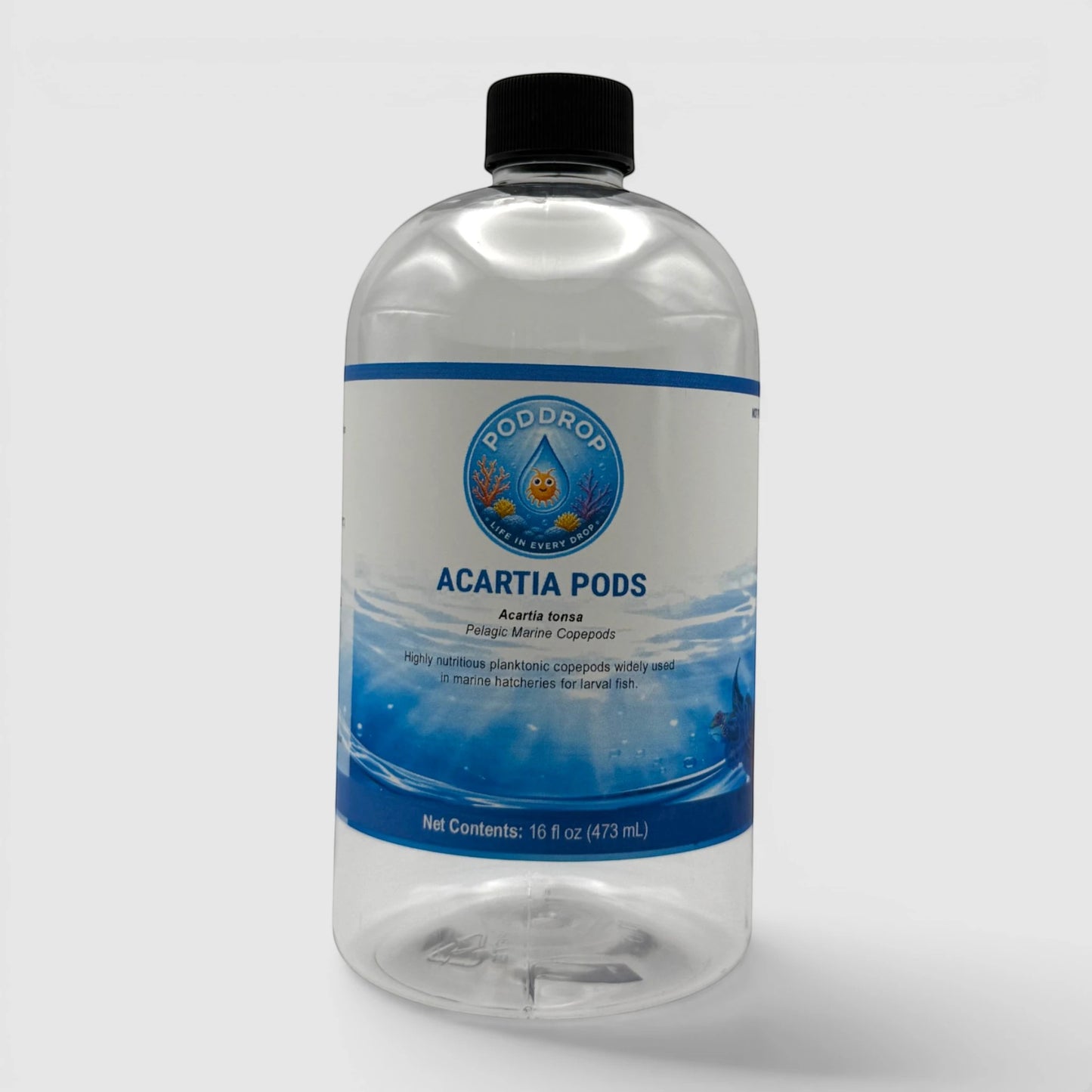
Acartia tonsa Copepods

Acartia tonsa Copepods

Regular price $25.00
Regular price Sale price $25.00
Sale Sold out
Shipping calculated at checkout.
LIVE CULTUREREEF SAFE MICROFAUNACULTURED BY PODDROP
Best for
Pelagic live feedLarval rearingHatchery workCulture programs
Size
Quantity
Auto-Ship & Save (Cancel Anytime)

Auto-renews, skip or cancel anytime.

Auto-Ship & Save (Cancel Anytime)

Auto-renews, skip or cancel anytime.

To add to cart, go to the product page and select a purchase option

Product overview

Product Overview

Acartia tonsa is a live cultured marine copepod offered as supplemental prey for compatible aquarium animals and as starter material for a separate culture or refugium. It is a calanoid copepod that spends substantial time swimming in the water column. Actual behavior, visibility, persistence, and suitability vary with the aquarium and the animals present.

This product can add live-prey movement and life-stage variety to a feeding program. Use it alongside an appropriate varied diet. Establishment, reproduction, continued survival, feeding response, coloration, and other aquarium outcomes are not guaranteed.

Each bottle contains a living culture prepared at PodDrop’s Arizona aquaculture facility. Organism density and life-stage distribution naturally vary. Follow the current label, storage directions, and Live Arrival Policy.

View full details

WHY THIS CULTURE

Live prey, microfauna, and habitat—matched by species.

Copepod species differ in relative size, swimming behavior, habitat use, and culture requirements. The right choice depends on what you want the culture to do.

Live prey diversity

Provides living prey across life stages; actual availability in a system depends on habitat, predation, feeding, and husbandry.

Microfauna support

Introduces a defined copepod culture that can contribute to a broader living food web when system conditions are suitable.

Species-specific behavior

Benthic, mixed-zone, and pelagic copepods behave differently. Use the profile below to match habitat and feeding goals.

Culture-first handling

Treat the bottle as a living culture: receive promptly, follow product-specific handling, and avoid unnecessary environmental stress.

BEST FIT WHEN

This profile matches the job.

The organism, relative scale, habitat, and intended application match the system you are planning.

CONSIDER ANOTHER CULTURE WHEN

You need a different biological profile.

You need a different prey size, habitat profile, microalgae type, or culture workflow.

CULTURE PROFILE

Technical at a glance.

Use this profile as a fast biological check before moving into detailed handling, comparison, and research notes.

01 • SCIENTIFIC NAMEAcartia tonsa Copepods
02 • CULTURE TYPELive culture
03 • LIFESTYLEProduct dependent
04 • MOVEMENTSpecies dependent
05 • RELATIVE SIZESee species guide
06 • PRIMARY ROLEAquarium or culture use
07 • CULTURE FEEDSee culture guide

FROM BOTTLE TO SYSTEM

Know what you are receiving—and what to do next.

Live cultures are biological products. The most useful receiving and use guidance is specific to the organism and the role you expect it to perform.

WHAT’S INSIDE THE BOTTLE?

What you may see in a copepod bottle.

A live copepod culture can contain multiple life stages. Visibility varies by species, life stage, density, bottle position, lighting, and whether organisms are swimming or resting on surfaces.

  • Adults are not the only living stage in a copepod culture.
  • Small nauplii and copepodites can be difficult to see without magnification.
  • Some species spend substantial time on bottle walls, bottom surfaces, or other structure.

WHERE IT FITS

Pelagic copepods use the water column

These cultures are selected when water-column availability and live-feed applications are more important than benthic reef seeding.

Conceptual habitat guide — not a literal distribution guarantee.
01

Receive promptly

Bring the shipment inside after delivery and inspect the package and culture condition.

02

Prepare the target area

Choose the display, rockwork, refugium, or culture vessel that matches the species profile and intended use.

03

Add the culture

Introduce the culture in a way that gives the organisms access to appropriate habitat while limiting unnecessary immediate removal or predation.

04

Support the population

Provide appropriate habitat and compatible food sources. Establishment and persistence depend on system conditions and are not guaranteed.

UNDER THE MICROSCOPE

Microscopy & visibility

Copepod cultures may include nauplii, copepodites, and adults. The smaller stages can be difficult to see without magnification, and some species spend significant time on surfaces.

01

Naked eye

Larger adults may be visible as moving points, while smaller stages can be easy to miss.

02

Low magnification

Useful for confirming movement, body shape, and multiple life stages in a sample.

03

Species profile

Relative size and behavior matter: a Tisbe bottle will not look the same as a Tigriopus or pelagic calanoid culture.

Compare copepod profiles
VISIBILITY REFERENCE Microscopic life looks different at each scale.

Use movement, life-stage expectations, and the species profile together. A live culture should not be judged only by what is obvious in the unopened bottle.

COMPARE THE PROFILE

How this copepod compares.

Tisbe, Tigriopus, and Apocyclops illustrate why “copepods” are not one interchangeable product. Relative size, habitat use, and swimming behavior change the best application.

ProfileTisbeTigriopusApocyclops
Relative adult profileSmallLargerSmall–medium
Primary habitatBenthic / surfacesSurfaces / culture vesselMixed zones
MovementCrawling + short burstsActive, visible burstsActive swimming
Strong use caseReef seeding / refugiumVisible prey / culture workReef + propagation

Know what you are adding

Culture details, care & handling

Product-specific metafields appear here when available, with practical fallback guidance for every item.

Key benefits & applications
Live Acartia tonsa culture for supplemental marine aquarium feeding
Calanoid copepods that spend substantial time swimming in the water column
Can add live-prey movement and life-stage variety to a varied feeding program
Can be used as starter material for a separate culture or refugium
Species highlights
<em>Acartia tonsa</em> is a calanoid copepod that spends substantial time swimming in the water column. This description is a taxonomic and behavioral identification, not a claim of superior nutrition or guaranteed aquarium performance. Density, sex ratio, and life-stage distribution vary among live culture bottles.
Nutritional profile
Live copepods provide intact moving prey and can contribute life-stage and behavioral variety to a marine feeding program. Their biochemical composition varies with species, developmental stage, culture diet, harvest timing, and post-harvest handling.

PodDrop does not guarantee fixed percentages of protein, lipid, EPA, DHA, amino acids, carotenoids, or vitamins unless a current product-specific laboratory analysis is published. Use as supplemental live prey within a varied feeding program, not as a complete diet or a treatment for health, color, immunity, or disease.
How to add or use
1. Unpack promptly and inspect the sealed container before transferring the culture.
2. Follow the product label. If the container temperature differs substantially from the aquarium, briefly float the sealed container to reduce the difference; avoid prolonged acclimation unless the label directs it.
3. Add the culture to the display, sump, refugium, or a separate culture vessel according to the intended use. Temporary changes to filtration are optional and system-dependent.
4. Monitor livestock and water quality after introduction. Do not assume a particular dose will establish a persistent population.
Storage & care
Use the live culture promptly. Until use, keep it at the stable temperature and light conditions stated on the product label, protected from direct sun and temperature extremes. Do not freeze.

Holding time, aeration, and feeding requirements differ among species and package formats, so do not apply a generic multi-day storage promise. Use clean tools and avoid introducing aquarium water into the original container.
Live Arrival Policy

PodDrop’s Live Arrival Policy covers the condition of eligible live products at the carrier’s first delivery attempt. If a culture appears nonviable, materially leaking, missing, or incorrect because of a PodDrop packing or fulfillment error, contact PodDrop within 2 hours of the carrier’s recorded delivery time.

Keep the culture and all original packaging. Before adding, transferring, feeding, or discarding the product, provide your order number, delivery timestamp, a concise description, and clear photographs or video showing the culture in its original container, the shipping box and insulation, any damage or unusual condition, and the shipping label.

PodDrop reviews each report using the order record, carrier tracking, delivery conditions, packaging, documentation, and reported handling after delivery. If a claim is approved, PodDrop may provide a replacement of the affected item or store credit, depending on the circumstances and current product availability.

Coverage does not guarantee establishment, reproduction, continued survival, feeding response, aquarium performance, or compatibility after receipt. Read the complete Live Arrival Policy for eligibility requirements, exclusions, and submission instructions.

Shipping schedule
Orders containing live products ship on PodDrop’s published live-product schedule using the carrier service stated at checkout. PodDrop may delay dispatch when weather or carrier conditions create an avoidable live-shipping risk.

Because live products are perishable, they are not returnable after shipment. Qualifying delivery-condition reports are governed by the current Live Arrival Policy and its 2-hour documentation requirement. Request order changes before fulfillment begins.
Responsible handling
Cultured and packed at PodDrop’s Arizona aquaculture facility (AQ License #91). This facility statement is not a claim that a culture is axenic, sterile, pathogen-free, parasite-free, or free of every incidental organism unless a current lot-specific test states otherwise.

Wash hands after handling, use dedicated culture tools when possible, prevent cross-contamination among cultures, and never release aquarium organisms or culture water into natural waterways. Follow all applicable local rules.

RECEIVING & TECHNICAL NOTES

Living products deserve clear handling.

Keep the purchasing experience simple at the top of the page, then make the deeper handling and technical information easy to find when a customer needs it.

RECEIVING

Open and inspect promptly.

Inspect the culture on arrival before adding, feeding, or discarding it. If there is an arrival concern, document the condition promptly under the published Live Arrival Policy.

Live Arrival Policy →
STORAGE & CARE

Follow the culture—not a generic rule.

Use the live culture promptly. Until use, keep it at the stable temperature and light conditions stated on the product label, protected from direct sun and temperature extremes. Do not freeze.

Holding time, aeration, and feeding requirements differ among species and package formats, so do not apply a generic multi-day storage promise. Use clean tools and avoid introducing aquarium water into the original container.
Receiving FAQ →
TECHNICAL / RESEARCH

Go deeper when the protocol demands it.

Copepod performance and persistence depend on species, life stage, prey size, habitat, feeding, predation pressure, and culture conditions. Use the species guide for a more technical profile.

Research & professional use →

VERIFIED CUSTOMER FEEDBACK

What customers say about PodDrop