

A Complete Guide to Reef Nutrition Copepods for Your Aquarium
Copepods are arguably the single most important live food you can introduce to build a truly natural, self-sustaining aquarium. These tiny crustaceans are the micro-engine for your entire system, providing the essential reef nutrition copepods deliver to everything from your corals to the most finicky fish.
Don't think of them as just another supplement. Think of them as the very foundation of a healthy marine food web you're building in your own home.
The Hidden Engine Powering Your Reef Ecosystem
Let's shift your perspective for a moment. Instead of seeing your reef tank as just a beautiful display, imagine it as a miniature, living ocean. In that ocean, the invisible force driving its health and stability is the humble copepod.
These tiny crustaceans are the unsung heroes of the aquarium world, constantly working behind the scenes to keep your tank balanced and vibrant. Much like the unseen worms and insects on a forest floor, they are absolutely critical for cycling nutrients and kickstarting a complex food web.
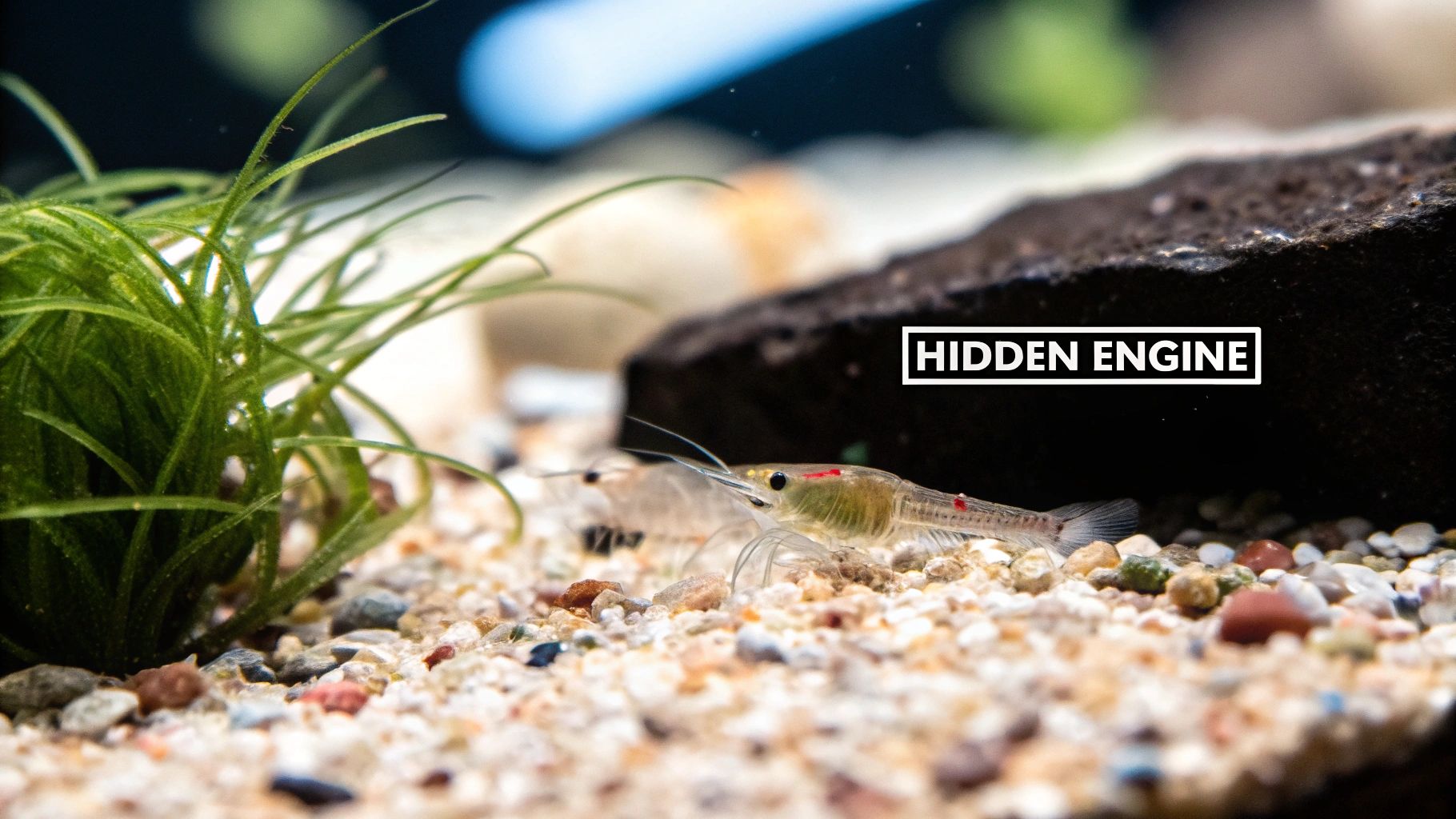
This guide isn't just about 'adding pods.' It’s about strategically establishing a cornerstone of natural reef biodiversity. Once you really get what they do, you're on your way to creating a truly thriving underwater world.
Why Copepods Are More Than Just Fish Food
Yes, they're an amazing food source, but limiting them to that role sells them way short. A healthy, reproducing copepod population provides continuous, round-the-clock support for your entire aquarium.
- A Natural Cleanup Crew: Benthic (bottom-dwelling) copepod species are relentless scavengers. They constantly graze on uneaten food, fish waste, and that ugly film algae before it can break down and spike your nitrates and phosphates.
- Live, Bite-Sized Coral Food: Many corals are surprisingly active predators. The tiny copepod nauplii (larvae) and small adults are the perfect meal, delivering essential fatty acids that directly fuel coral growth and boost their coloration.
- The Key for Finicky Eaters: Some of the most stunning fish, like Mandarin Dragonets and certain wrasses, depend almost exclusively on a live diet of microfauna. For them, a robust pod population isn't a luxury—it's the key to survival.
By establishing a self-sustaining population of copepods, you are creating a living, breathing cleanup crew and a perpetual food source all in one. This lightens your maintenance load while dramatically increasing the overall stability and health of your reef.
The scientific community has caught on, too. Over the last two decades, research papers focused on copepods have jumped from 10% to 20% of all live feed research, a direct reflection of their superior nutritional profile compared to other options. You can dive deeper into the growing focus on copepods in aquaculture to see just how valued they've become.
Meet the Copepods Your Reef Needs
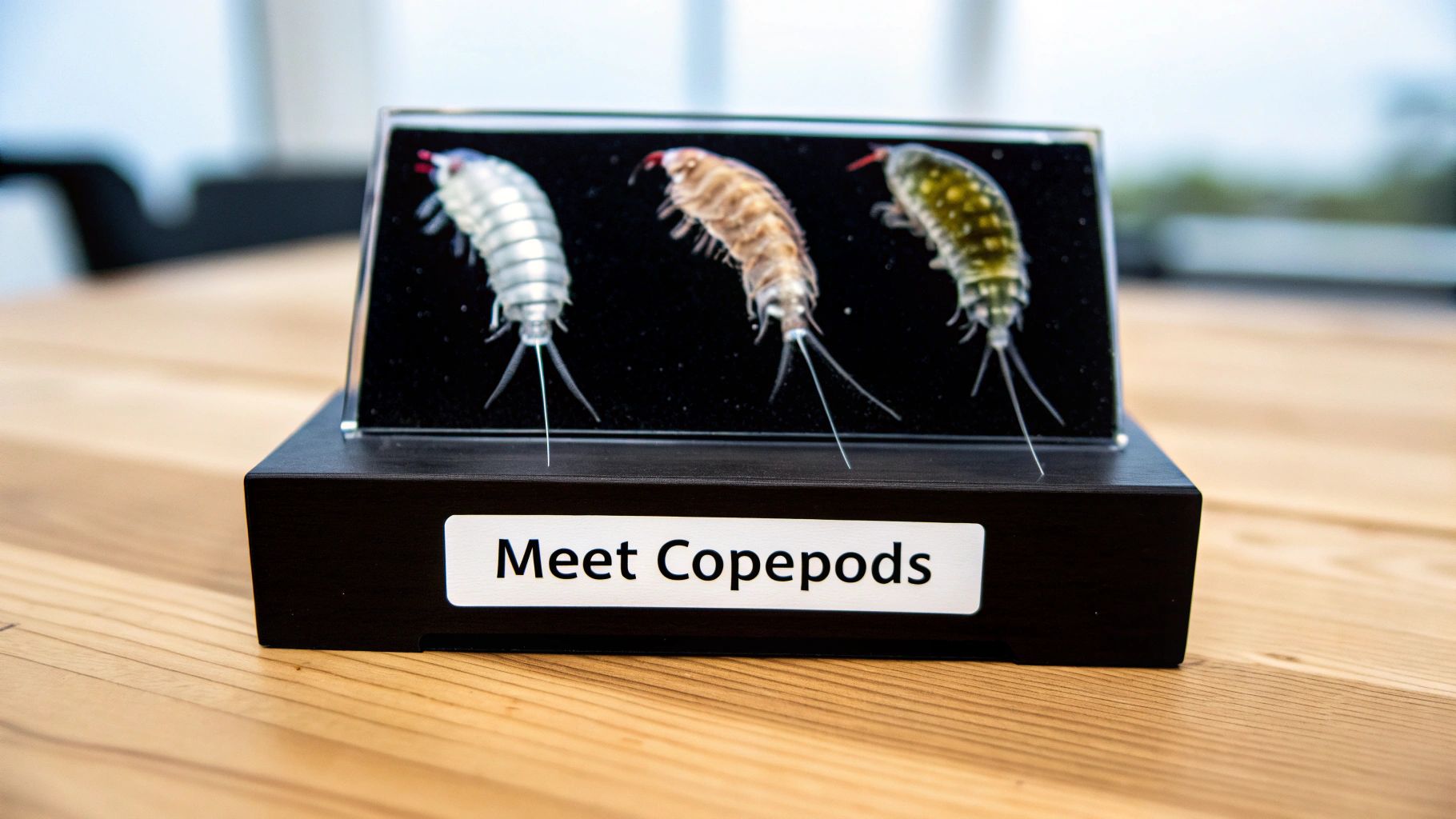
It’s easy to fall into the trap of thinking "a pod is just a pod," but that's one of the biggest misconceptions in reef keeping. The reality is that the copepod world is incredibly diverse. Picking the right species for your tank is like choosing the right tool for a job—each one has its own size, behavior, and niche that makes it perfect for a specific purpose.
Getting to know these differences is what separates a good tank from a great one. It’s the key to satisfying that finicky Mandarin Dragonet, establishing a self-sustaining food web, or just running a cleaner, more balanced system. Let's dig into the three workhorses of the aquarium hobby so you can make a smart choice for your reef.
Tisbe: The Benthic Housekeeper
Think of Tisbe biminiensis as the tireless, microscopic janitor of your sandbed and rockwork. This species is benthic, meaning it lives its life crawling on surfaces instead of swimming freely through the water. They are the ultimate homebodies.
This is exactly what makes them a phenomenal part of your cleanup crew. They spend their days and nights munching on detritus, leftover fish food, and those annoying films of algae right where they grow. Because they’re so good at hiding in tiny crevices, your fish can't easily wipe them out, giving them a real chance to establish a permanent, breeding population.
- Key Behavior: Sticks to the substrate and rockwork, rarely venturing into the open water.
- Primary Benefit: Fantastic for seeding a refugium to create a self-sustaining food source that doubles as a cleaning crew.
- Ideal for: Coral-heavy tanks, where their tiny larvae (50–100μm) are a perfect bite-sized meal for polyps, and for anyone wanting to boost their tank's biodiversity for the long haul.
Tigriopus: The Energetic Swimmer
Now, picture a completely different critter—one that’s bigger, bolder, and zips through the water with a jerky motion that screams "EAT ME!" to fish. That's Tigriopus californicus in a nutshell. Their "start-stop" swimming pattern is an irresistible feeding trigger.
Because they are larger and hang out in the water column, they are an immediate, high-value meal. They are loaded with essential fatty acids, making them an incredible conditioning food for fish you intend to breed or for fattening up a new, skinny arrival.
The larger size and active swimming of Tigriopus make them an ideal choice for direct feeding. Their jerky movements trigger a strong predatory response in fish, making them an excellent tool for getting reluctant eaters to feed.
Apocyclops: The Pelagic Hunter's Prize
Finally, let’s look at Apocyclops panamensis. You can think of this species as the perfect middle ground, specializing in life out in the open. Apocyclops are pelagic, meaning they actively swim throughout the water column, making themselves constantly available to anything that wants a snack.
Their constant movement and small-to-medium size (80–150μm) make them the perfect prey for fish that hunt in the water column, like anthias, wrasses, and of course, the notoriously picky Mandarin Dragonet. Even better, they reproduce like crazy, allowing them to quickly populate a tank or fuge and provide a steady stream of nutrition.
This makes them a top choice for simultaneously feeding both fish and corals that capture food particles from the water. Their life cycle ensures a continuous supply of nutritious food is always drifting through your system.
Choosing the Right Copepod for Your Aquarium
A comparative overview of common copepod species to help you select the best option for your reef tank's specific needs and inhabitants.
Selecting the best copepod—or, more often, a blend of them—comes down to what your tank truly needs. A system with a hungry Mandarin has very different requirements than an SPS-dominant tank focused on coral color. This table lays out the key differences to help guide your decision.
| Copepod Species | Primary Role | Ideal For | Size (Adult) | Behavior |
|---|---|---|---|---|
| Tisbe biminiensis | Detritus Control & Seeding | Refugiums, coral feeding, establishing a permanent population | 50–100μm | Benthic (bottom-dwelling), crawls on surfaces |
| Tigriopus californicus | Direct Fish Feeding | Fattening fish, triggering feeding response, breeding projects | 200–500μm | Surface-dweller with a jerky, twitchy swimming motion |
| Apocyclops panamensis | Feeding Picky Fish & Corals | Mandarin Dragonets, anthias, LPS corals, seeding a display tank | 80–150μm | Pelagic (free-swimming), constantly moves in the water column |
Honestly, for most reef tanks, the best strategy is to use a mix. Why choose one when you can have them all? A quality blend like the Harmony Pod blend from PodDrop Live Aquarium Nutrition combines multiple species to colonize every part of your tank—the sandbed, the water column, and all the rockwork. This approach builds a much more resilient and diverse ecosystem, ensuring every single one of your tank's inhabitants gets exactly what it needs to thrive.
How to Seed and Sustain Your Copepod Population
Getting a healthy copepod colony started in your tank is all about giving them a smooth transition. Think of it less like dumping them in and more like a gentle introduction to their new home. The first step is to avoid shocking them.
Simply float the sealed bag or bottle in your tank or sump for about 20 minutes. This lets the temperature equalize slowly, which is far less stressful for them.
Before you release them, be sure to turn off your skimmer, return pumps, and any high-flow powerheads. You want to give these tiny creatures a fighting chance to find a safe spot without being immediately blasted into the filter floss.
Choosing the Right Seeding Zone
Where you introduce your pods matters—a lot. You're looking for the quiet neighborhoods of your aquarium, places with low flow where they can settle in, hide, and start breeding.
Your best bets are the nooks and crannies in your live rock or a dense bed of macroalgae like chaetomorpha. From these safe havens, the population will naturally spread throughout the rest of your system over time.
- Low-flow spots give the baby copepods (nauplii) a safe place to grow up.
- Macroalgae clumps are a five-star resort, offering both food and shelter.
- Rubble zones or coarse sand beds create complex surfaces perfect for colonization.
Just like fish fry need to hide from predators, copepods need microhabitats to survive and establish themselves. So, be strategic when you pour them in. For the first few days, keep the lights dim in that area and try to minimize disturbances. This quiet period is crucial for the first generation to get a foothold.
Providing Consistent Nutrition
Once your copepods are settled in, they're going to get hungry. The key to a booming population is a steady food source, and for copepods, that means phytoplankton.
Think of phytoplankton as the foundation of their diet. A regular schedule of 2–3 additions per week will keep the population well-fed and actively reproducing.
"A stable food source is the foundation of a resilient live feed system," says marine biologist Dr. Lee.
High-quality phytoplankton strains like Nannochloropsis or Isochrysis are fantastic choices, especially for gut-loading the pods with nutrients that will eventually be passed on to your fish and corals. A light, daily dose directly into your refugium is a great way to provide a constant food source without fouling your display tank's water.
Balancing Habitat and Flow
A successful copepod colony finds the sweet spot between good habitat and the right amount of water movement. You want enough flow to circulate food, but not so much that it's a constant hurricane sweeping them away.
High-turbulence zones are a no-go; they'll just send your pods straight into the filter or skimmer. Gentle, indirect circulation is what you're aiming for, something that mimics the natural currents they'd experience on a reef.
Here are a few practical tips:
- Place macroalgae in a part of your refugium that gets moderate, but not direct, flow.
- Use adjustable powerheads to dial in the water movement around your rockwork.
- Ensure your sand or rubble beds are deep enough to let benthic species burrow and thrive.
Creating a mix of safe anchoring surfaces and controlled flow zones is the secret to replicating the coastal ecosystems where these creatures flourish.
Leveraging Aquaculture Trends
The push for sustainable live foods isn't just a hobbyist trend; it's a major shift in the entire aquaculture industry. Between 2005 and 2014, aquaculture grew by 5.8% annually, and in 2014, for the first time ever, farmed fish production surpassed wild-caught fish.
This massive growth created a huge demand for high-quality live feeds, cementing copepods as an essential tool for both commercial hatcheries and home aquarists. You can read more about these findings in this plankton research article.
This context really drives home why reef nutrition copepods have become an industry standard, not just a "nice-to-have" for reef keepers.
For a detailed walkthrough, check out our guide on How to Add Copepods to Tank for more step-by-step tips.
Monitoring and Maintenance Tips
Keep an eye on your pod population. You don't have to be a scientist, but a quick weekly check can tell you a lot. A simple way to do this is to shine a flashlight into the tank after the main lights are off and see how many you can spot scurrying on the glass and rocks.
Observing their numbers will help you spot any potential issues before they become big problems.
- If you notice the population dwindling, try reducing your skimmer's run time or turning it off for a few hours overnight.
- If you have a population explosion and they're covering every surface, it might be a sign you're overfeeding phytoplankton, or you may need a fish (like a mandarin) to help keep them in check.
A little fine-tuning is all it takes to maintain a healthy balance. With stable water parameters and a consistent routine, your tank will soon have a self-sustaining copepod colony.
Troubleshooting Common Challenges
What if your copepod population stalls or suddenly crashes? Don't panic. It's almost always due to one of a few common culprits:
Poor water quality or sudden parameter swings.
Overactive filtration or a skimmer that's pulling them out too quickly.
Not enough food, or an inconsistent feeding schedule.
If you run into trouble, start by slowing down your filtration. Turn the skimmer to a drier skim, or pause any aggressive chemical filtration like carbon and GFO for a bit. Re-evaluate your flow patterns and double-check that you're providing enough phytoplankton. Often, a small adjustment is all it takes to bring the colony roaring back to life.
Final Takeaway
Seeding and sustaining reef nutrition copepods is a blend of art and science. It’s about understanding their needs and creating the right environment for them to thrive.
By choosing the right seeding zones, offering a steady supply of food, and fine-tuning your tank's flow, you’re not just adding pods—you're cultivating a permanent, living food web. With a bit of observation and care, these tiny crustaceans will become a self-renewing resource that boosts coral vitality, satisfies finicky eaters, and brings your entire reef ecosystem closer to its natural state.
The Direct Link Between Copepods and Coral Vitality
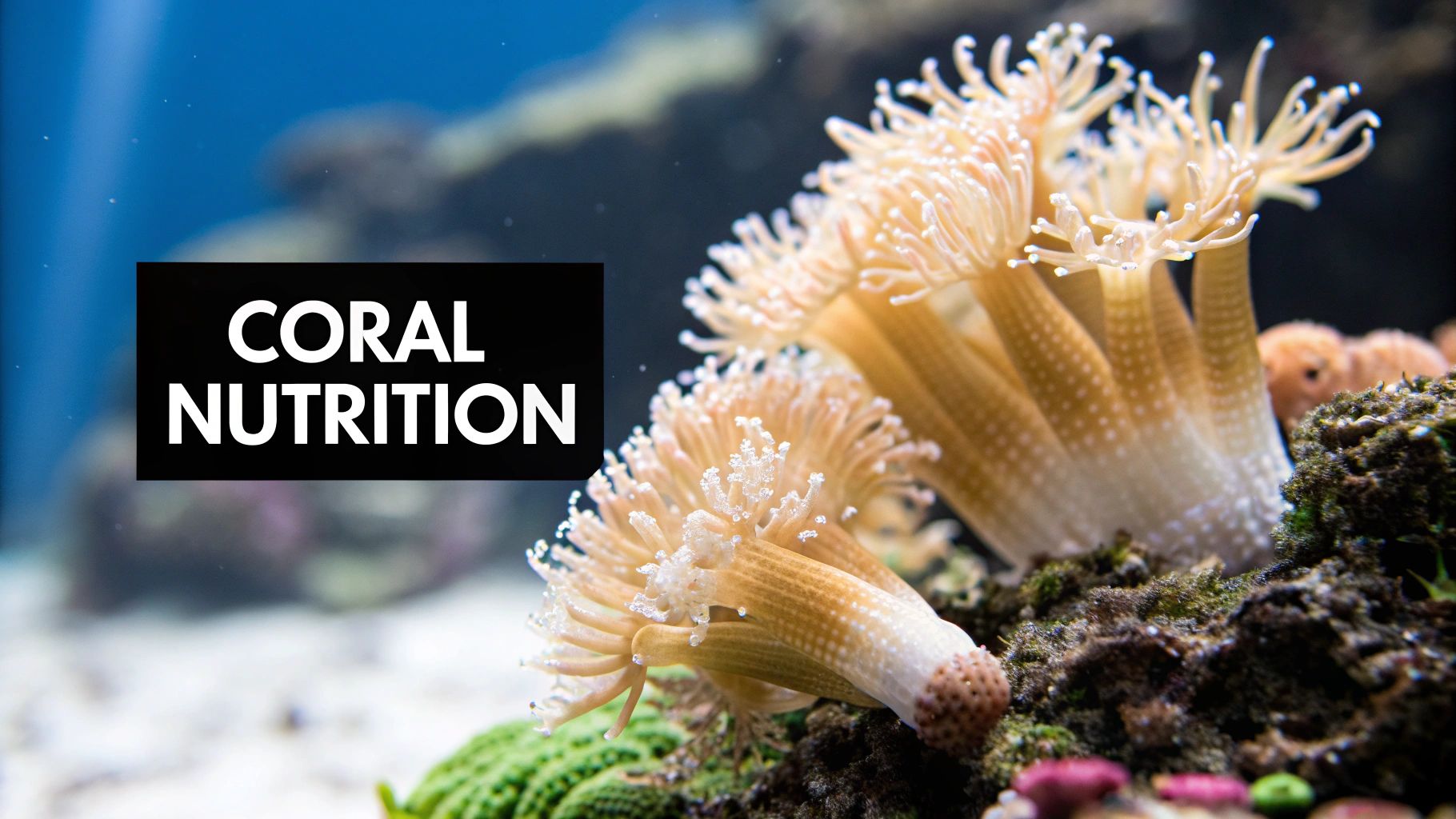
It’s one of the biggest myths in reef keeping: corals get all the food they need from light. While their symbiotic zooxanthellae are absolute workhorses, they mostly just pump out sugars. It's energy, yes, but it’s not the whole story.
For corals to truly build tissue, fight off disease, and show off those stunning colors, they need to hunt. They need real food.
This is where the direct connection between reef nutrition copepods and coral vitality comes into sharp focus. A thriving population of live copepods provides the essential fatty acids, lipids, and proteins that light simply can't offer. Think of it this way: light gives your corals their carbs, but copepods serve up the protein and healthy fats.
A coral running only on photosynthesis is just getting by. A coral actively snacking on pods is thriving.
Fueling Growth and Coloration
When a coral eats a copepod, it’s getting a perfectly balanced meal. Copepods are loaded with Highly Unsaturated Fatty Acids (HUFAs)—like EPA and DHA—which are the fundamental building blocks for cell membranes and tissue regeneration.
When your corals have access to this kind of high-quality food, the results are obvious:
- Accelerated Growth: The proteins and lipids are exactly what corals need to build out their skeletons (for SPS) and plump up their tissue (for LPS). In fact, some studies have shown that corals fed with live prey can grow up to 25% faster than those left to rely on light alone.
- Deeper, Richer Colors: Copepods contain natural pigments called carotenoids. When corals consume them, they absorb these pigments, which directly boosts their reds, pinks, and oranges. The result is a more vibrant, dynamic reef.
- Better Polyp Extension: Look at a tank teeming with pods, and you'll see corals with their polyps out, actively reaching for food. This is a tell-tale sign of a happy, well-fed coral that feels secure enough to hunt.
A constant, drifting supply of live food encourages natural feeding responses. This does more than just fill a coral's belly—it strengthens its immune system, making it tougher and more resilient against common tank stressors like temperature swings.
Matching the Pod to the Polyp
Of course, not all corals eat the same way. That's why having a mix of copepod species in your tank is so effective. Different corals are built to capture different-sized prey.
The entire copepod life cycle becomes a buffet for your reef. The tiny, microscopic nauplii (the baby copepods) are the perfect mouthful for small-polyp stony (SPS) corals like Acropora and Montipora. As those pods grow into adults, they become a much more substantial meal for the big, fleshy mouths of large-polyp stony (LPS) corals like Frogspawn and Hammers.
This natural variety ensures that every inhabitant in a mixed reef—from the smallest frag to the biggest colony—gets a meal that’s just the right size.
Don't forget that what your pods eat, your corals eat. Our guide on using live phytoplankton for reef tank health explores how this microalgae supercharges the nutritional value of your copepods. This gut-loading process essentially turns every pod into a tiny, swimming multivitamin, delivering maximum benefit straight to your corals.
Solving the Puzzle of Feeding Finicky Fish
Every reef keeper has a story about one. That absolutely stunning fish they just had to have, only to watch it slowly fade away. Think of the psychedelic Mandarin Dragonet or the ghost-like Pipefish—species famous for being frustratingly difficult to keep. The issue is rarely a lack of effort. It’s a fundamental mismatch between what we offer and what they’ve evolved to eat.
These aren't your typical aquarium fish. They are highly specialized micropredators. Out on the reef, they spend their entire day meticulously hunting, plucking hundreds of tiny living critters from every nook and cranny. For these fish, a teeming population of live copepods isn't a bonus snack; it's the only thing that keeps them alive.
This is why flakes and pellets just don't work. A Mandarin Dragonet doesn't even register a floating pellet as food. Its brain is hardwired to detect the specific, jerky movements of live prey. This makes a self-sustaining population of reef nutrition copepods non-negotiable for their long-term health.
Replicating the Natural Foraging Experience
To succeed with these delicate species, you need a shift in thinking. Stop focusing on "feeding the fish" and start "cultivating their food." By establishing a healthy copepod population, you're essentially creating a living pasture inside your aquarium, allowing these specialized hunters to graze all day long, just like they would in the ocean.
This constant access to food is the real game-changer. A fish like the Mandarin Dragonet has an incredibly fast metabolism and needs to eat almost nonstop. A couple of feedings a day simply won't cut it. It needs a 24/7 hunting ground.
- Behavioral Enrichment: The act of hunting keeps fish stimulated and active, which significantly reduces stress and brings out their natural behaviors.
- Superior Nutrition: Live copepods are loaded with essential fatty acids and proteins that you just can't get from processed foods. This translates directly to vibrant colors and better overall health.
- Constant Food Supply: A breeding pod population means there's always food available, perfectly matching the grazing needs of these demanding fish.
When you seed your tank and refugium with a mix of species like Apocyclops and Tisbe, you're building a resilient food web. The free-swimming Apocyclops are easy pickings for fish hunting in the open water, while the bottom-dwelling Tisbe create a hidden, self-replenishing food bank among the rocks and sand.
The secret to keeping finicky fish isn't about finding the perfect prepared food. It's about building a micro-ecosystem within your tank that allows the fish to feed itself naturally and sustainably.
Beyond a Single Fish: The Ecosystem Benefit
Getting that prized fish to thrive is a fantastic feeling, but the ripple effects of a healthy pod population benefit your entire tank. Introducing a diverse blend of copepods kicks your aquarium's biodiversity into high gear, leading to a far more stable and resilient environment.
These tiny crustaceans become a crucial food source for far more than just your picky eaters. Corals, filter-feeding invertebrates, and even the fry from your other fish will all feast on the constant supply of nutritious, bite-sized meals. On top of that, they're a tireless cleanup crew, munching on detritus and nuisance film algae before it can impact your water quality.
It all creates a beautiful, positive feedback loop. The pods clean the tank, which leads to better water. Better water supports healthier fish and corals, which in turn helps the pod population flourish. Your aquarium transforms from a static glass box into the dynamic, interconnected ecosystem it’s meant to be. For those looking to get really specific, our guide on choosing the best mandarin dragonet food dives even deeper into these strategies.
Understanding Lab-Cultured Copepod Quality
Not all copepods are created equal, and the difference shows up in your tank’s health. While wild-harvested pods can be hit or miss, reef nutrition copepods from a controlled lab environment guarantee consistency and safety. Imagine the contrast between foraging wild mushrooms and buying from a trusted farmstand—no unwanted surprises.
The Science Of Purity And Consistency
In a professional aquaculture lab, every detail is under the microscope. Technicians track water chemistry, fine-tune filtration, and keep a close eye out for hydroids or nuisance algae. The aim is simple: deliver nothing but the exact copepod species you need, free of contaminants.
Lab-cultured copepods offer precise species verification and a pathogen-free profile, making them a worry-free addition to your reef.
With this level of oversight, each bottle arrives packed with healthy, ready-to-feed pods. You get a reliable live food source that bolsters your ecosystem without introducing new problems.
The Challenge Of Large-Scale Production
Scaling up copepod culture demands serious resources. At its heart lies microalgae—your pods’ primary food. In fact, sourcing and growing enough phytoplankton can account for 70% of total cultivation costs.
Modern closed-batch systems have boosted productivity, hitting an average of 22 million eggs per day. Still, output directly depends on a steady algae supply. Interrupt that flow, and production stalls.
Key Cost Drivers:
- Phytoplankton Volume: Essential nutrition for copepod growth.
- Water Quality Management: Filtration, sterilization, and monitoring.
- Specialized Labor & Equipment: Skilled staff and dedicated culture tanks.
For a deeper dive into the mechanics behind these numbers, see this comprehensive guide on marine copepod culture.
Ultimately, opting for lab-cultured copepods means investing in a science-backed solution. Your corals and fish will thrive on a pure, potent source of nutrition—nothing less than the best foundation for vibrant growth.
Common Questions About Copepods in a Reef Tank
Even after you're sold on the benefits of copepods, a few practical questions always seem to pop up. Let's tackle some of the most common ones I hear from fellow hobbyists so you can add them to your tank with confidence.
Will Copepods Overrun My Tank?
This is probably the number one concern, but let me put your mind at ease: it's almost impossible for this to happen. In any reef tank with fish, corals, or other inverts, you have a built-in team of predators that will happily keep the copepod population in balance.
If you do see a sudden explosion of copepods, don't panic! It’s actually a great sign. It means your tank is healthy and loaded with the food they need to thrive, which in turn means your fish and corals have a 24/7 buffet. A healthy predator-prey relationship will always keep things from getting out of hand.
How Often Should I Add More Copepods?
There’s no single magic number here; it really depends on your goals and what's already happening in your tank.
Here are a few common approaches:
- Seeding a New Tank: Start with a good-sized initial dose to get a breeding population established. I often recommend adding a second batch about a month later to broaden the gene pool.
- Feeding Finicky Fish: If you have a demanding eater like a Mandarin Dragonet, you'll want to replenish the pods more often. Adding a fresh culture monthly or every other month ensures they have a constant, high-density food source.
- Boosting Biodiversity: For a mature tank, adding a new culture every 2–3 months is a fantastic way to keep the microfauna population diverse and robust.
Can I See Copepods In My Tank?
You sure can, but you'll need to do a little detective work. The best time to spot them is at night, about an hour after the main lights go out.
Turn off your pumps for a moment, grab a flashlight, and scan the glass and rockwork. You should see tiny white specks darting and crawling around—those are your pods! Benthic species like Tisbe will stick to surfaces, while pelagic types like Apocyclops will be free-swimming in the water. Seeing them is one of the best indicators that you're cultivating a truly living ecosystem.
Spotting copepods on your glass at night is one of the most reassuring signs that your tank's food web is active and self-sustaining. It confirms that your initial seeding was successful and a live food source is readily available.
Are Live Copepods Safe For All Corals?
Yes, 100%. Live copepods are an excellent and completely safe food for just about every coral you can think of—SPS, LPS, and softies alike.
The beauty is that the different life stages of the copepods offer something for everyone. The tiny nauplii (the babies) are the perfect bite-sized meal for small-polyp corals like Acropora. Meanwhile, the larger adults are a nice, meaty snack for LPS corals with big mouths, like Hammers and Torches. They pose zero risk and only offer pure, essential nutrition.
Ready to build a more natural, self-sustaining reef? PodDrop Live Aquarium Nutrition provides lab-cultured, pathogen-free copepods and phytoplankton to fuel a thriving ecosystem. Discover the right blend for your tank today.