

Your Guide to a Thriving Soft Coral Reef Tank
If you're looking to dive into the saltwater aquarium hobby, a soft coral reef tank is hands down one of the best places to start. It’s a visually stunning and remarkably forgiving way to get your feet wet, focusing on resilient corals like Zoanthids and Mushrooms that don’t come with the steep learning curve of their stony cousins. Success is just much more achievable.
Why Soft Corals Are Your Best Start in Reefing
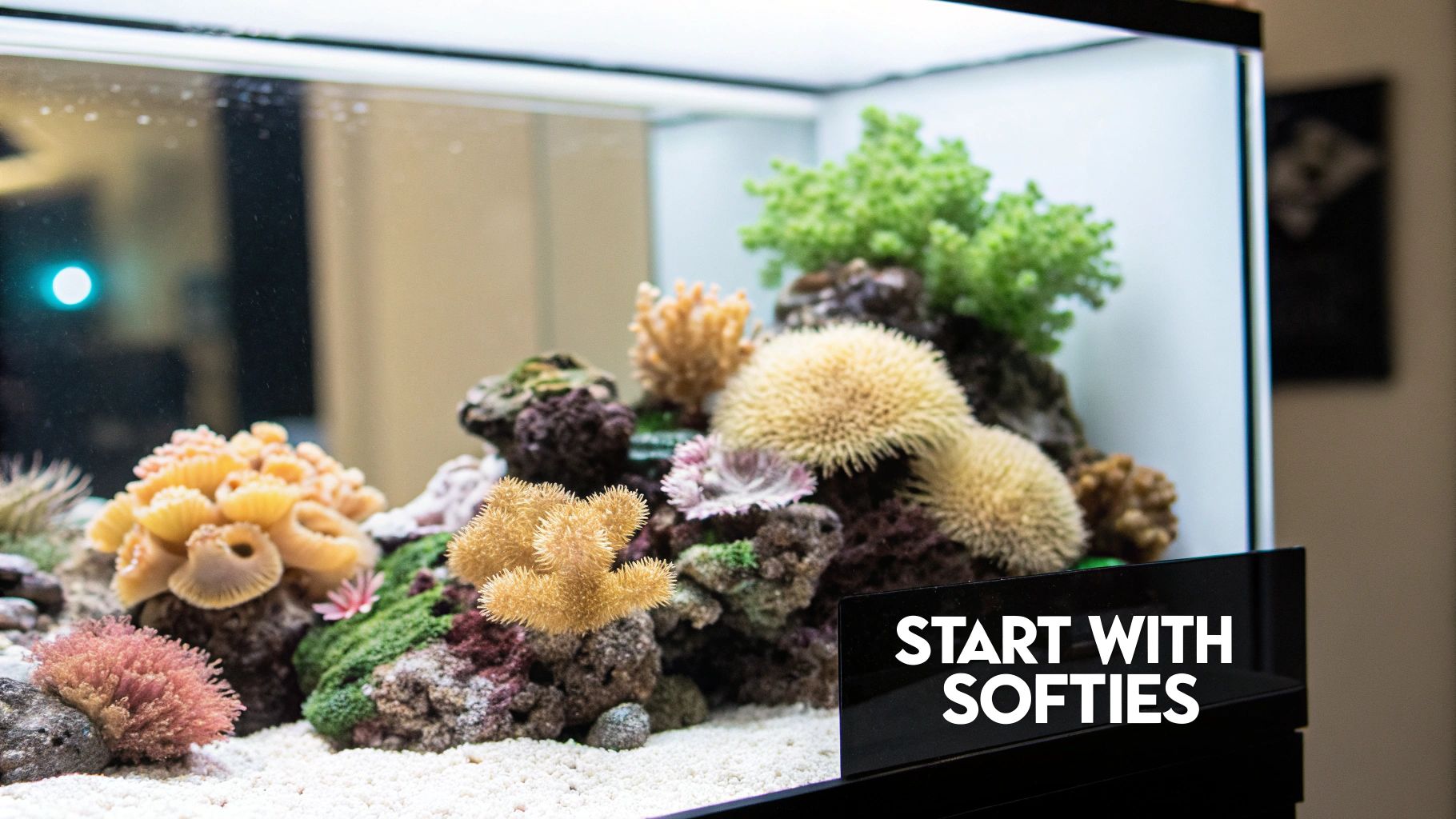
The very idea of a "reef tank" can be intimidating. People picture complex gear, precise chemical dosing, and corals that seem to die if you just look at them wrong. For a lot of folks, that image makes the whole hobby feel out of reach. But a soft coral tank completely flips that script, offering a rewarding and genuinely accessible path to creating your own slice of the ocean.
Unlike hard corals, which build rigid calcium carbonate skeletons, soft corals are pliable and adaptable. This inherent resilience is their superpower. They're far more tolerant of the small swings in water parameters that are almost guaranteed to happen when you're learning the ropes. A little mistake that might send a stony coral into a tailspin is often just a blip on the radar for a hardy softie.
The Allure of Movement and Simplicity
One of the most captivating things about a soft coral tank is the constant, gentle motion. Corals like Toadstool Leathers and pulsing Xenia sway gracefully in the current, creating a living, breathing aquascape that is truly mesmerizing. This natural movement brings an energy to the tank that a more static setup just can't match.
Better yet, their care requirements are refreshingly straightforward.
- Lighting: Forget the super-expensive, high-intensity lighting rigs. Softies thrive under more budget-friendly and less demanding lights.
- Flow: Gentle, indirect water movement is all they need. This is much easier to create than the powerful, chaotic flow some other reefs demand.
- Feeding: Many soft corals are photosynthetic, getting most of their energy from light. You can easily supplement this with simple broadcast feeding.
It's worth remembering that many seasoned hobbyists, even those with decades of experience, started their journey with a simple soft coral setup. It’s a proven path that builds foundational skills and confidence without overwhelming you.
A Growing and Accessible Hobby
This accessibility has fueled a huge surge in the hobby’s popularity. The global reef aquarium market was valued at USD 4.9 billion in 2020 and is projected to hit USD 11.0 billion by 2028. This isn't just a number; it reflects a massive, growing community of enthusiasts who are discovering the joys of reefing. For you, that means more resources, better equipment, and a stronger community to lean on. You can read more about the growth of the reef aquarium market to see just how big it's getting.
By choosing to start with a soft coral reef tank, you’re not taking a shortcut—you’re making a smart start. You'll learn the essential husbandry skills, get a real feel for the rhythm of a marine ecosystem, and enjoy a beautiful, thriving aquarium from the get-go. This foundation makes the journey enjoyable and sets you up for long-term success, whether you decide to stick with softies or tackle other challenges down the road.
Choosing the Right Gear for Your Soft Coral Tank
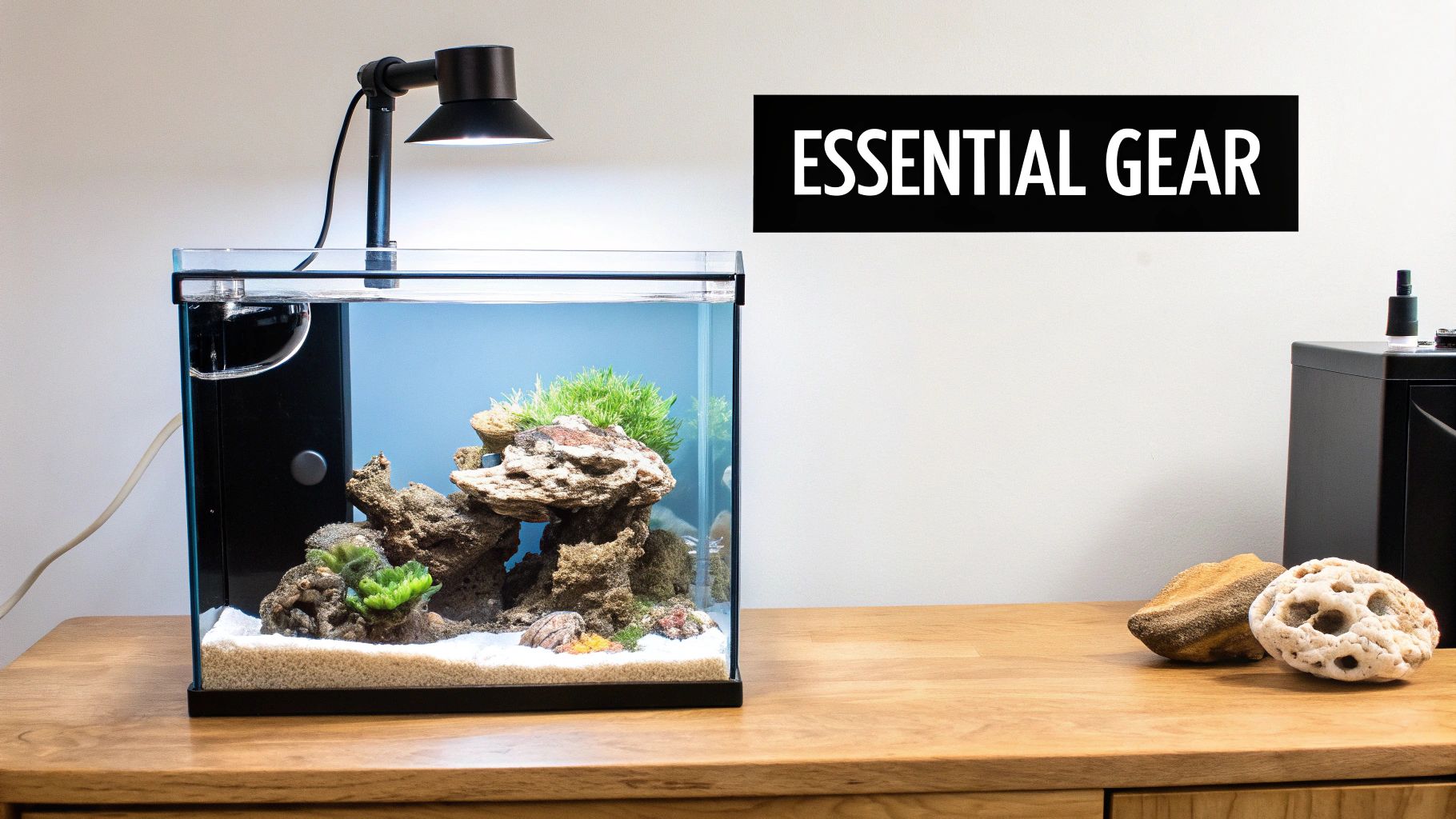
Walking into a local fish store or browsing online can feel like stepping into a maze of gadgets. Brands are shouting from every corner, and it's easy to get overwhelmed or, worse, spend a ton of money on gear you just don't need.
Here’s the good news: soft corals are incredibly forgiving. This means your first tank setup doesn't have to break the bank. We’re aiming for reliability and stability, not the flashiest tech. The right equipment makes creating a stable environment a whole lot easier. Let's dig into the essentials.
The Tank Itself: All-In-One vs. Custom Setups
Your first big choice is the aquarium itself. For anyone just getting their feet wet, an All-In-One (AIO) tank is hands-down the best way to go. These tanks have built-in back chambers that neatly hide all the essential gear—the filter, pump, and heater—giving you a clean, uncluttered view. They are about as close to "plug-and-play" as you can get in this hobby.
The alternative is a custom setup, which means a separate tank, stand, and a sump (a filter box that sits in the stand below the tank). This route gives you tons of flexibility for adding bigger, more powerful equipment like oversized protein skimmers or a refugium. But it also means dealing with plumbing, which adds a layer of complexity. If that sounds like your kind of project, our guide on setting up a saltwater sump made simple is a great place to start.
Beginner's Tip: Start with an AIO tank somewhere between 20 and 40 gallons. It’s the sweet spot—big enough to keep your water parameters from swinging wildly but small enough to be totally manageable as you learn the ropes.
Lighting That's Just Right
One of the best parts about a soft coral tank? You don’t need to shell out for a ridiculously powerful light. Unlike their stony cousins (SPS/LPS corals), which need intense light to build their skeletons, most soft corals are perfectly happy under moderate, full-spectrum LEDs.
So, what should you look for?
- Controllability: Get a light that lets you adjust the intensity and the color spectrum. This way, you can dial in the exact look you want while giving your corals the light they need to pop.
- PAR Value: You don't need a PAR (Photosynthetically Active Radiation) monster. A light that can deliver 50-150 PAR at the bottom of the tank is plenty for popular softies like Zoanthids, Mushrooms, and most Leather Corals.
- Spread: Make sure the light covers the whole tank evenly. You don't want dark corners where nothing will grow.
Plenty of affordable LED fixtures from good brands are built for exactly this kind of tank, so there’s no need to overspend here.
Creating Gentle Water Movement
Soft corals come from parts of the reef where the water gently sways—they aren't built to withstand a firehose. Your goal is to create a soft, randomized flow pattern that keeps detritus from settling but doesn't blast your corals into oblivion.
This is where powerheads (or wavemakers) come in. For a smaller tank, one or two small powerheads on opposite ends of the tank will do the trick. Look for models with adjustable flow settings so you can fine-tune the movement. The goal is to see a gentle, rhythmic sway in your corals' polyps, not to see them plastered against the rocks.
The Foundation of Filtration
Here's a secret: filtration in a reef tank is more about biology than it is about gear. Your true filter is your live rock and sand bed. This is where the magic happens. All that surface area becomes a home for billions of beneficial bacteria that drive the nitrogen cycle, turning fish waste into harmless gas.
But that biological foundation works best with a little help from some key equipment.
- Protein Skimmer: Honestly, this is a game-changer. A skimmer pulls organic gunk out of the water before it has a chance to break down and fuel algae. It’s the single best tool for keeping your water crystal clear and your nutrient levels in check. You can find plenty of nano skimmers designed to fit right into the back chamber of an AIO.
- Heater: A stable temperature is non-negotiable. Don’t cheap out on your heater. Get a quality submersible heater with a reliable thermostat, and maybe even an external controller for an extra layer of protection.
- Filter Media: The back chambers of your AIO are perfect for some simple, effective media. A bit of filter floss will polish the water, a small bag of activated carbon will pull out impurities, and some porous ceramic rings will give your beneficial bacteria even more real estate to grow on.
With these components sorted, you'll have everything you need. To make it even easier, here's a simple checklist breaking down the gear.
Soft Coral Tank Equipment Checklist
Here’s a quick rundown of the gear you'll need. We've separated the absolute must-haves from the nice-to-haves to help you prioritize.
| Component | Essential or Optional | Key Consideration for Soft Corals |
|---|---|---|
| Aquarium (AIO) | Essential | 20-40 gallons is the ideal starting size for stability and manageability. |
| LED Lighting | Essential | Look for adjustable, full-spectrum LEDs capable of 50-150 PAR. |
| Powerhead(s) | Essential | Aim for gentle, indirect, and randomized flow. Adjustable models are best. |
| Live Rock & Sand | Essential | The foundation of your biological filtration. More is usually better. |
| Heater | Essential | Stability is crucial. Get a reliable model with a thermostat. |
| Refractometer | Essential | For accurately measuring salinity. More reliable than hydrometers. |
| Test Kits | Essential | You'll need kits for Alkalinity, Calcium, Nitrate, and Phosphate at a minimum. |
| Protein Skimmer | Optional (but highly recommended) | Dramatically improves water quality by removing waste before it breaks down. |
| Auto Top-Off (ATO) | Optional | Automatically replaces evaporated water to keep salinity stable. A huge time-saver. |
| Filter Media | Optional | Filter floss, carbon, and bio-media can supplement your primary filtration. |
This list covers the core components for a successful soft coral tank. Start with the essentials, and you can always add the optional gear later as you get more comfortable with your system.
Mastering Water Chemistry and Stability
A breathtaking soft coral tank isn't the result of frantically chasing perfect numbers on a test kit. Far from it. The real secret is creating an incredibly stable environment where your corals can settle in and truly thrive. Let's break down the essential water chemistry so you can stop worrying about the numbers and focus on consistency.
You can forget the laundry list of parameters you might see for other types of reef tanks. For a system focused on soft corals, we get to narrow our attention to just a few core elements. Getting these right—and more importantly, keeping them steady—is the key to long-term success. The goal is to mimic the ocean's consistency, not to micromanage every element down to the last decimal.
This stability starts with the water itself. You absolutely must begin with Reverse Osmosis Deionized (RO/DI) water. Using tap water is a non-starter; it’s like rolling the dice with a cocktail of chlorine, heavy metals, phosphates, and silicates that are basically rocket fuel for nuisance algae and a major source of stress for your corals. RO/DI water gives you a clean, pure foundation to build upon.
Your Core Water Parameters
Once you have that pure water, you'll mix it with a quality reef salt. While different brands have slightly different recipes, any reputable salt mix will get you into the ideal range for a thriving reef. The trick is to pick one brand and stick with it. This simple choice is a huge step toward maintaining consistency.
Here are the main numbers you’ll want to keep an eye on:
- Salinity: This is just a measure of the salt content in your water. You're shooting for a specific gravity of 1.025 to 1.026. A calibrated refractometer or a digital probe is your best friend here—those cheap plastic swing-arm hydrometers are notoriously unreliable and not worth the headache.
- Temperature: Soft corals are happiest in a stable temperature range of 75-78°F (24-26°C). The most critical factor is avoiding rapid swings. A quality heater is non-negotiable, and plugging it into an external temperature controller is a fantastic failsafe.
- Alkalinity (dKH): Think of this as your water's ability to resist pH swings. For a soft coral tank, a steady 8-11 dKH is the sweet spot. Remember, small daily fluctuations are far more stressful than a stable number that's a little high or low.
- Calcium (Ca): While softies don't build massive skeletons, they still need calcium for their basic biological functions. Keeping a stable level between 400-450 ppm is perfect.
- Magnesium (Mg): This element is the unsung hero that helps keep your alkalinity and calcium in balance. Aim for a range between 1250-1350 ppm.
Don't get caught up in the "chasing numbers" game. An aquarium with alkalinity that is rock-solid at 8.5 dKH is infinitely healthier than one that swings from 8.0 to 10.0 every week while you try to hit some "perfect" target. Stability is the name of the game.
Managing Nutrients and the Nitrogen Cycle
Beyond those core five, you'll need to manage your nutrients—specifically, nitrates and phosphates. For any new tank, the first hurdle is establishing the nitrogen cycle. This is the natural process where beneficial bacteria convert toxic ammonia from fish waste into nitrite, and then into the much less harmful nitrate.
You can kickstart this cycle by adding an ammonia source, like a pinch of fish food or a bottled bacteria product, to your tank full of live rock and sand. Over a few weeks, you'll test the water and watch the ammonia and nitrite levels spike, then fall to zero. Once both are undetectable and you start seeing a nitrate reading, your tank is cycled and ready for its first inhabitants.
After that initial cycle, your goal is to keep nitrates and phosphates low, but not zero.
- Nitrates: A healthy target for a soft coral tank is between 2-10 ppm.
- Phosphates: These need to be kept quite low, ideally below 0.05 ppm, as they are a primary driver of ugly nuisance algae.
Your best tool for keeping these nutrients in check is the humble water change. For most nano or medium-sized tanks, a simple 10-20% water change every one to two weeks does a fantastic job of exporting waste and replenishing essential trace elements. If you want to take a deeper dive into managing this key nutrient, check out our complete guide to reef aquarium phosphate levels.
By focusing on these key parameters and getting into a simple routine of testing and water changes, you'll build the stable foundation your soft coral reef needs to truly flourish.
How to Select and Place Your First Corals
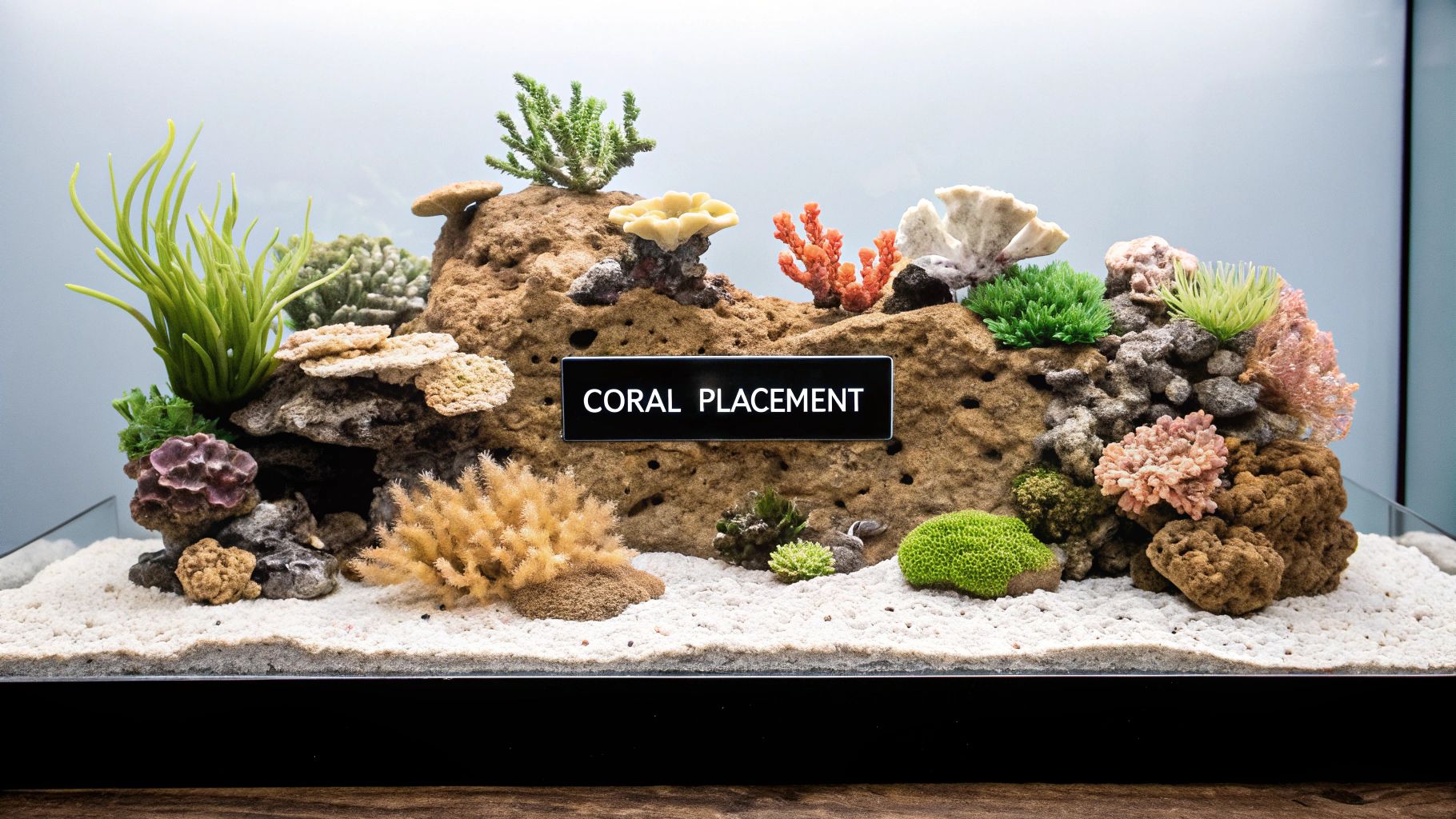
Alright, your tank is stable and the cycle is complete. Now comes the best part: bringing that rockwork to life with your first corals. This is the moment your tank transforms from a sterile glass box into a genuine, living ecosystem.
The trick is to start smart. By choosing corals known for their toughness and easy-going nature, you set yourself up for success and get to build confidence as your reef matures. This isn't just about grabbing the brightest colors; it's about understanding how each coral will grow, behave, and get along with its neighbors. A little planning now prevents a lot of coral-on-coral warfare down the road.
Your Starting Lineup of Hardy Soft Corals
For anyone just dipping their toes into soft corals, you simply can't go wrong with these proven winners. They’re the tried-and-true workhorses that form the foundation of countless jaw-dropping reef tanks.
- Mushroom Corals (Discosoma & Rhodactis): These are, without a doubt, some of the easiest corals on the planet. They come in an insane variety of colors, prefer lower light and flow, and are incredibly forgiving if your parameters swing a little.
- Zoanthids and Palythoas: Often called "Zoa's and Paly's," these button-like polyps spread into dense, colorful mats. They're perfect for adding splashes of intense green, orange, and blue to your rocks and enjoy moderate light and flow.
- Toadstool Leather Corals (Sarcophyton): A phenomenal centerpiece coral. A Toadstool Leather has this captivating, gentle swaying motion and grows from a small mushroom shape into a large, wavy crown. It’s a perfect focal point for any aquascape.
- Green Star Polyps (GSP): GSP is ridiculously hardy and grows a brilliant, neon green carpet over anything it touches. It's fantastic for covering a back wall or an overflow box, but give it space—it grows fast and will take over if you let it.
These corals are popular for a reason. They deliver a huge visual punch for minimal fuss, making them the perfect gateway into the reef-keeping hobby.
Aquascaping for Growth and Harmony
Placing your corals is more art than science, but there's definitely a strategy to it. You have to think less about what looks good today and more about what will work six months from now when things start growing in. Smart placement prevents corals from stinging, shading, or simply growing over each other.
Think of your tank as having different zones of light and flow. The very top of your rockwork gets blasted with light and current, while the sandbed and lower caves are much calmer. You need to match the coral to the zone. For example, a Toadstool Leather will love a mid-level spot with decent flow, while delicate Mushroom Corals are much happier tucked away in a lower-light, gentle-flow area.
If you’re working with a larger tank and want some layout inspiration, our practical guide to a 50-gallon reef aquarium has some great ideas.
Pro Tip: When you bring a new coral home, don't glue it down right away. Place the frag plug in a few different spots over a couple of days. The coral will tell you where it's happiest through its polyp extension and color. Listen to it!
The Smart Choice of Aquacultured Corals
When you're shopping, you’ll see corals labeled as either wild-collected or aquacultured (farmed). Do yourself a huge favor and stick with aquacultured corals. These guys are already used to aquarium life, which makes them far hardier and quicker to adapt to your tank's specific conditions.
Even better, supporting coral farming helps take the pressure off natural reefs. Soft coral aquaculture has become a cornerstone of a sustainable hobby, with some species having growth cycles as short as 4 to 12 months. This efficiency makes it an economically and ecologically sound practice that keeps the aquarium trade supplied. Choosing aquacultured corals means you get a healthier animal and you support a more responsible industry.
Building a Sustainable Maintenance Routine
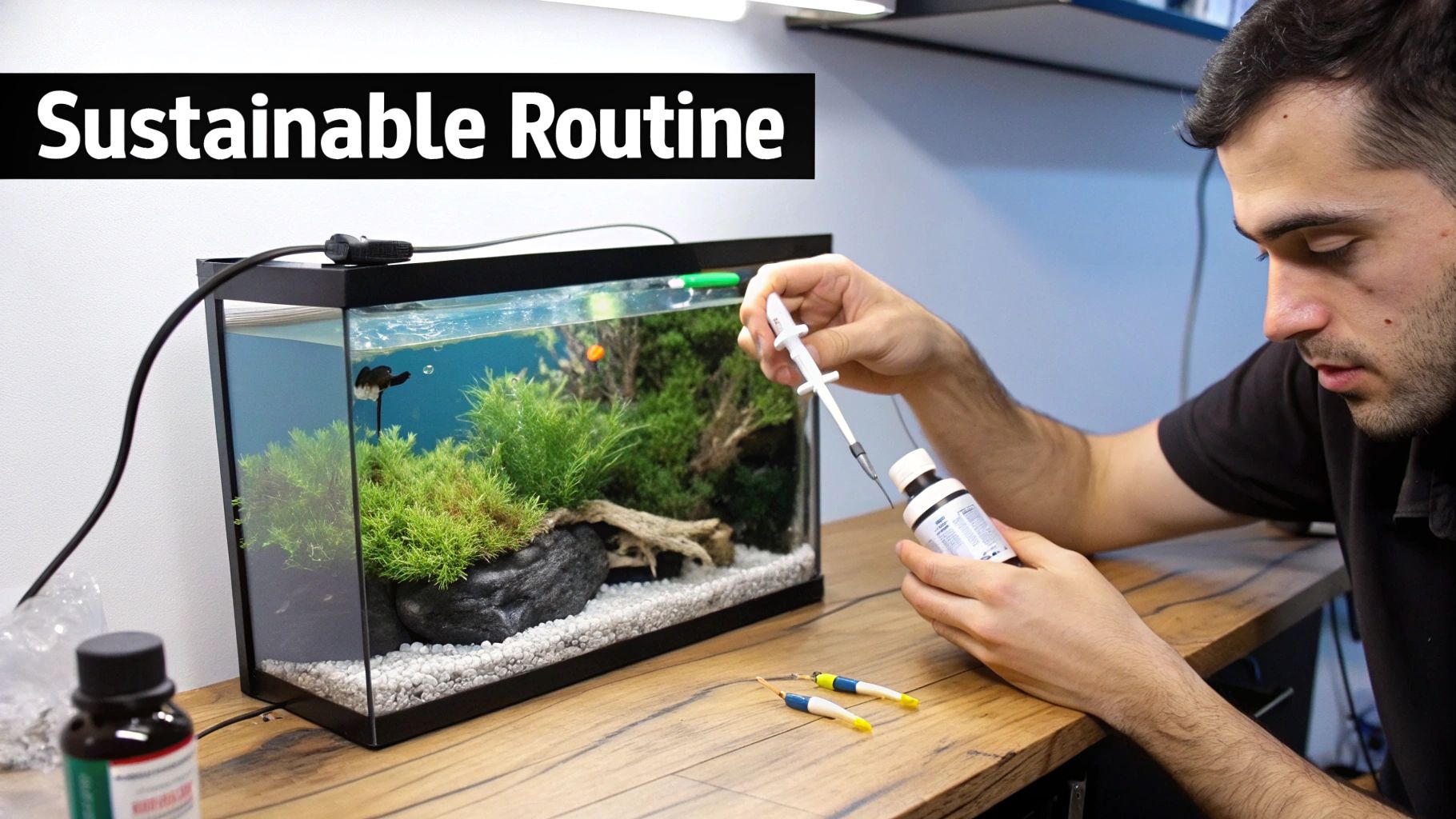
Long-term success with a soft coral reef tank doesn't come from big, dramatic interventions. It’s built on the quiet foundation of simple, consistent habits that eventually become second nature. Getting into a sustainable rhythm for feeding and maintenance is what turns a nice aquarium into a thriving, stable ecosystem that really goes the distance.
A solid routine is all about preventing problems before they even start, keeping your water pristine and your corals happy. The goal here is to craft a predictable schedule you can actually stick to—one that feels more like a rewarding ritual than a long list of chores.
Fueling Your Reef with Targeted Nutrition
Sure, many soft corals get a lot of energy from their symbiotic zooxanthellae and the lights you provide, but they're still animals that need to eat. Targeted feeding is what takes a tank from just surviving to truly flourishing, and you’ll see the payoff in better color, growth, and overall vitality. This is where building a living food web really shines.
Adding live nutrition like phytoplankton and copepods does more than just feed your corals; it fuels the entire micro-ecosystem. Copepods will happily graze on bits of nuisance algae and detritus, keeping the tank cleaner, while phytoplankton consumes excess nutrients like nitrates and phosphates right out of the water column. When your corals snag these tiny organisms, they’re getting a perfectly complete meal.
A simple, effective feeding strategy could look something like this:
* Live Phytoplankton: Dose your tank 2-3 times per week, following the bottle’s directions for your tank size. A few milliliters per 10 gallons of water is a common starting point.
* Live Copepods: Add a fresh culture of copepods, like those from a PodDrop blend, every 4-6 weeks. This keeps the population robust and ensures there’s always a food source for your corals and any small fish you might have.
This approach builds a more natural and self-sustaining food chain right inside your aquarium. Instead of just dumping in processed foods that can rot and spike your nutrients, you're introducing living organisms that actively improve the tank's stability and health.
Developing Your Maintenance Rhythm
Consistency is everything. A chaotic, "I'll fix it when it's broken" mindset is a fast track to nutrient spikes, algae blooms, and stressed-out corals. The trick is to break down the work into manageable daily, weekly, and monthly checks so the whole process feels effortless.
This schedule isn't set in stone; it's a template. Feel free to tweak it based on your tank's specific needs and your own lifestyle. The key is finding a rhythm that works for both you and your reef.
Daily Habits: The Five-Minute Check
These are quick visual inspections that take less time than making a cup of coffee. Think of them as your first line of defense, letting you catch small issues before they blow up.
- Headcount and Behavior: Are all your fish and inverts present and acting normally?
- Coral Polyp Extension: Are your corals open and looking happy? Retracted polyps can be an early warning sign of stress.
- Temperature Check: A quick glance at the thermometer confirms your heater is doing its job.
- Equipment Function: Is water flowing? Is the skimmer bubbling? A simple "yes" to both is all you need.
Weekly Tasks: The Foundation of Stability
Set aside 30-60 minutes each week for the heavy lifting. Lots of reefers pick a weekend morning to make this a regular ritual. This is when you actively manage water quality and pull nutrients out of the system.
- Water Testing: Test your key parameters—salinity, alkalinity, nitrate, and phosphate. It's a great idea to log your results in a notebook or an app so you can spot trends over time.
- Water Change: A 10-20% water change is your primary tool for exporting nitrates and replenishing essential trace elements. Just be sure to use pre-mixed saltwater that's heated to match your tank's temperature.
- Glass Cleaning: Scrape any algae off the inside of the glass for a crystal-clear view.
- Filter Media Check: Give your filter floss a rinse or swap it out. If you're running carbon or other media, check if it's time for a replacement.
Monthly Responsibilities: The Deep Clean
Once a month, plan to spend a little extra time on equipment maintenance. This preventative care keeps your gear running efficiently and reliably, preventing those sudden failures that can put a whole tank at risk. It’s basically a tune-up for your reef's life support.
- Clean Powerheads and Pumps: Detritus and coralline algae love to build up on pumps, slowing down the flow. A quick scrub with a brush in a bucket of old tank water will get them running like new.
- Empty and Clean Protein Skimmer Cup: While you should empty the gunk from the skimmer cup weekly, a full cleaning of the collection cup and neck ensures it's working at peak performance.
- Siphon the Sandbed: During your water change, gently siphon any gunk that's collected in a small section of your sandbed.
By embracing this structured but flexible routine, you build a real partnership with your aquarium, making sure it stays a source of beauty and relaxation for years to come.
Common Soft Coral Reef Tank Questions
Even with the most solid game plan, you're going to have questions pop up as your soft coral reef tank starts to grow in and find its rhythm. That’s not just normal—it's part of the fun. This is where you’ll find answers to some of the most common hurdles and curiosities nearly every reefer faces at the beginning.
Getting clear, straight-to-the-point answers helps build your confidence and lets you tackle the next stage of your reefing adventure without second-guessing yourself. Let's dive into the questions that come up time and time again.
How Can I Tell If My Corals Are Stressed?
Learning to "read" your corals is probably one of the most important skills you'll develop in this hobby. A happy, healthy soft coral will be fully expanded, showing off its polyps to grab light and food from the water. When something’s off, they give you some pretty clear signals.
The usual signs of a stressed-out coral include:
- Retracted Polyps: This is the big one. If a coral stays closed up tight for a long time, it’s telling you it's not happy about something.
- Fading or Browning Color: Losing that vibrant pop of color can point to issues with your lighting or a dip in water quality.
- Excessive Slime: Some corals, especially leathers, will shed a waxy film as part of their normal growth. But if you're seeing a constant, heavy slime coat, it could be a sign of irritation from bad flow or even a pest.
Spot any of these? The very first thing you should do is grab your test kits and check your core water parameters. Stability is everything, and a sudden swing in alkalinity or salinity is often the culprit.
How Do I Deal with Pests Like Aiptasia?
It’s not a matter of if, but when you'll find Aiptasia in your tank. These small, pesky anemones can multiply like crazy and have a nasty sting that irritates nearby corals. Don't panic—they are totally manageable. The trick is to deal with them the moment you see them, before they stage a takeover.
You've got a few solid options for getting rid of them. You can directly inject the anemone with a product like Aiptasia-X or even some concentrated lemon juice, which essentially melts it away. For a more natural, long-term fix, you can bring in the biological cavalry. Adding specific critters like Peppermint Shrimp or a Bristletail Filefish to your cleanup crew works great, as they’ll actively hunt and eat Aiptasia for you.
When Is It Safe to Add My First Fish?
Patience is a virtue, and nowhere is that truer than here. Your tank needs to be fully cycled—meaning both ammonia and nitrite test at zero—before a fish even crosses your mind. This whole process usually takes anywhere from 3-6 weeks. Rushing it is a classic rookie mistake and a recipe for disaster, as the fish waste will quickly overwhelm a biological filter that isn't ready.
Once that cycle is officially complete, take it slow. Add just one or two small fish to start, and then give the tank at least a couple of weeks to adjust before adding anything else. This gives your beneficial bacteria population time to ramp up and handle the new bioload.
A thriving aquarium hobby is a significant part of a larger, growing market. Forecasts show the reef aquarium industry is set to expand from about USD 4.04 billion in 2025 to over USD 6 billion by 2032. The soft coral segment is a major driver of this growth, reflecting its popularity and accessibility. To understand the global trends better, you can explore more insights on the reef aquarium market.
This growth just goes to show you're part of a massive, passionate community. With a little bit of knowledge and a healthy dose of patience, you'll get past these common questions and be well on your way to watching your soft coral ecosystem flourish.
Ready to build that vibrant, living food web in your new tank? At PodDrop Live Aquarium Nutrition, we provide the fresh, high-quality live copepods and phytoplankton your soft corals and fish need to thrive.
Shop our live nutrition blends and start fueling your reef today!