

A Realistic Guide to Saltwater Tank Maintenance
Successful saltwater tank maintenance is all about getting into a consistent, sustainable groove. It's the blend of small daily checks, core weekly tasks, and the occasional monthly deep clean that stops problems dead in their tracks, keeping your reef aquarium stable and looking its best.
Building Your Reef Maintenance Rhythm
Let's be real: the idea of maintaining a saltwater tank can feel like a lot. But the secret isn't about spending hours every day tinkering with your system. The true key to a stunning, thriving reef is simple consistency. When you establish a repeatable routine, those complex-sounding tasks just become easy habits.
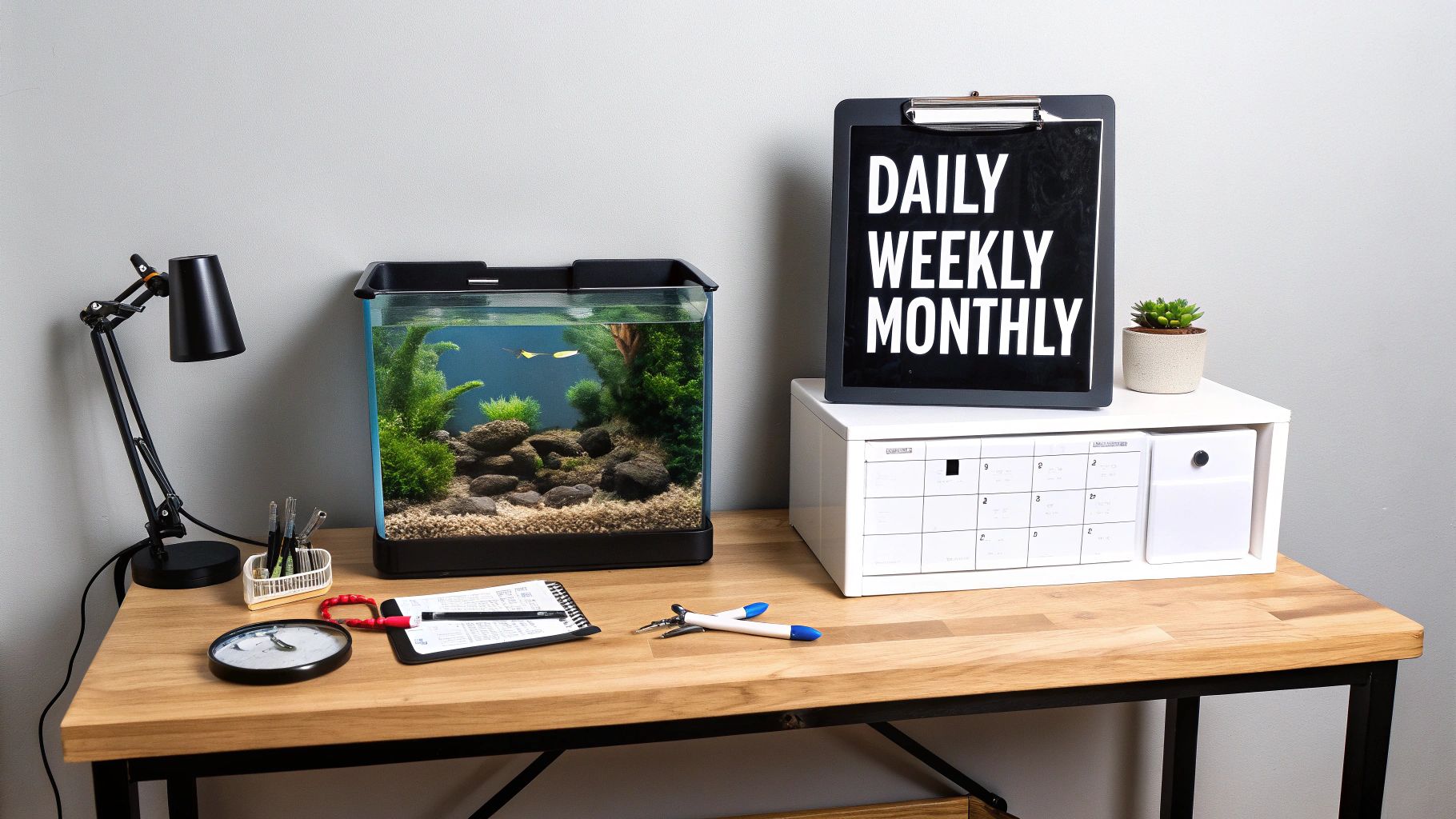
Think of this guide as a practical blueprint for your schedule, broken down into daily, weekly, and monthly actions. The goal is to create a rhythm that feels natural, not like a chore. Once you understand the 'why' behind each step, you'll be able to proactively manage your aquarium's health, which makes this hobby way more enjoyable.
To help you stay on track, here’s a quick overview of what a solid maintenance schedule looks like.
Your Saltwater Tank Maintenance Schedule at a Glance
This table breaks down the essential tasks and their recommended frequency to keep your reef aquarium in optimal condition. It's a great quick-reference tool to ensure you're covering all the bases.
| Frequency | Essential Tasks | Key Objective |
|---|---|---|
| Daily | Visual Health Check, Equipment Function Check, Temperature Check | Catch small issues early before they escalate into major problems. |
| Weekly | Water Testing, 10-15% Water Change, Glass Cleaning, Skimmer Cup Cleaning | Maintain stable water parameters and remove accumulated waste. |
| Monthly | Equipment Deep Clean, Sump & Refugium Tidy-up, Media Replacement | Ensure life support equipment runs efficiently and prevents nutrient buildup. |
By following this general cadence, you'll create a stable environment where your corals and fish can truly flourish.
The Five-Minute Daily Check
Honestly, the most crucial part of your routine takes less time than brewing your morning coffee. A quick daily visual inspection is your best first line of defense. You're not looking for perfection; you're just looking for anything that’s different from yesterday.
This daily scan is simple:
- Fish and Invert Health: Are all your fish accounted for? Do you see any odd behavior like rapid breathing, clamped fins, or new spots? Are your corals puffed up and showing good color?
- Equipment Function: Is water flowing from your return pumps and powerheads like it should be? Is the protein skimmer bubbling away and making that nice, dark skimmate? A quick glance confirms your tank's life support is online.
- Water Clarity and Temperature: Is the water crystal clear? Check your thermometer or digital controller to make sure the temperature is holding steady in its target range, usually 75-78°F (24-26°C).
This simple habit helps you catch small problems—like a snail getting stuck in a pump intake—before they turn into big emergencies.
Your Essential Weekly Habits
The weekly checklist is where the real work of saltwater tank maintenance gets done. These are the non-negotiable tasks that have a direct impact on water quality and the long-term stability of your reef. I find it best to set aside a specific time each week to knock these out.
Maintaining stable water parameters is the absolute cornerstone of success. In fact, an estimated 70-80% of reef aquarium failures can be traced back to swings in salinity, pH, or nutrient levels. Historical data even shows that a huge number of new hobbyists quit within the first year because of parameter crashes, often from skipping these weekly tasks. You can learn more about these market trends in aquarium water treatment.
The goal of weekly maintenance isn't just to clean; it's to reset the balance of your miniature ecosystem. You're removing waste and replenishing vital elements that your corals and fish consume.
Your weekly routine should lock in these key tasks:
- Water Testing: Test your core parameters: salinity, alkalinity, calcium, magnesium, nitrate, and phosphate. Writing these down in a logbook is a game-changer for spotting trends over time.
- Water Change: Pulling out 10-15% of the water is critical. It removes the nitrates and phosphates that build up and, just as importantly, adds back essential trace elements.
- Cleaning: Use an algae scraper on the glass, empty and rinse out that protein skimmer collection cup, and siphon any gunk you see on the sandbed or bare bottom.
- Dosing and Feeding: Top off your auto-dosing containers and feed any specialized foods your system needs, like adding phytoplankton to keep your copepods and corals happy.
This structured weekly approach is what prevents that slow, creeping decline in water quality that often leads to nasty algae outbreaks and stressed-out inhabitants. Make it a habit, and your reef will thank you by being a vibrant, healthy environment.
Translating Water Tests into Action
At first, your water testing results might feel like you're trying to read a foreign language. Seeing a bunch of numbers for alkalinity, calcium, or phosphate doesn't mean much until you understand what they represent—they're the voice of your aquarium. Learning to interpret these results is the most powerful skill in saltwater tank maintenance, turning you from a passive observer into a proactive reefkeeper.

This isn't about chasing perfect, textbook numbers. It's all about creating stability. Corals and fish can adapt to slight variations, but they absolutely despise rapid swings. Your real goal is to keep key parameters within a safe, stable range, making small, gradual corrections only when they start to drift.
The Big Three: Alkalinity, Calcium, and Magnesium
These three elements are the absolute foundation of coral skeletal growth. Think of them as the concrete, rebar, and structural beams of a building—you need all of them, and in the right ratios, to build something strong. If one is out of whack, the others can't be properly used by your corals.
- Alkalinity (dKH): This is arguably the most critical parameter to watch. It measures the water's buffering capacity, which is its ability to resist pH swings. Corals are constantly consuming carbonate to build their skeletons, so your dKH levels are always being depleted. Target Range: 8-12 dKH.
- Calcium (Ca): This is the primary building block for coral skeletons and that purple coralline algae we all love. Calcium levels need to be kept in proportion to alkalinity. Target Range: 400-450 ppm.
- Magnesium (Mg): This element plays a crucial supporting role. It essentially prevents calcium and carbonate from clumping together and precipitating out of the water. Without enough magnesium, trying to maintain stable alkalinity and calcium is nearly impossible. Target Range: 1250-1350 ppm.
A classic beginner mistake is trying to fix low calcium by dumping in a supplement without checking magnesium first. If your magnesium is low, that extra calcium will just precipitate out, clouding up your water without giving your corals any benefit. Always test and adjust these three together.
Managing Nutrients: Nitrate and Phosphate
Nitrate and phosphate are the natural end products of the nitrogen cycle, coming from fish waste and leftover food. While they're essential for life in trace amounts, letting them get too high is the number one cause of nuisance algae outbreaks and can even slow down coral growth.
The real art of nutrient management is finding the "sweet spot" for your specific tank. A heavily stocked system with lots of fish and frequent feedings will need much more aggressive nutrient export than a simple tank with a few small fish and soft corals.
Your strategy for keeping these nutrients in check should be multi-faceted.
- Water Changes: This is the most direct way to dilute and remove nutrients. A consistent 10-15% weekly water change is a fantastic baseline for exporting dissolved organics.
- Protein Skimming: Your protein skimmer is your first line of defense. It yanks organic waste out of the water before it has a chance to break down into nitrate and phosphate. Keep it clean and tuned for a perfect skim.
- Refugium: A well-lit refugium growing macroalgae like chaetomorpha is a powerhouse natural filter, consuming nutrients as it grows.
- Controlled Feeding: This one's simple: only feed what your fish can gobble up in a minute or two. Overfeeding is the fastest way to fuel an algae farm.
Core Water Parameters Cheat Sheet
Keeping your parameters stable is the heart of successful saltwater tank maintenance. Use this table as a quick reference guide during your weekly testing routine.
| Parameter | Ideal Range | What It Means | Corrective Action (If Drifting) |
|---|---|---|---|
| Salinity | 1.025-1.026 sg | Measures the salt content in the water. Stability is key. | Low: Add saltwater. High: Add RODI freshwater. |
| Alkalinity | 8-12 dKH | Buffering capacity; essential for coral skeleton growth. | Low: Dose a reputable alkalinity supplement slowly. |
| Calcium | 400-450 ppm | Primary building block for corals and coralline algae. | Low: Dose a calcium supplement. Check Mg first. |
| Magnesium | 1250-1350 ppm | Stabilizes alkalinity and calcium, preventing precipitation. | Low: Dose a magnesium supplement before Ca/Alk. |
| Nitrate (NO₃) | <10 ppm | Nutrient from waste breakdown; fuel for algae. | High: Water change, reduce feeding, check skimmer. |
| Phosphate (PO₄) | <0.05 ppm | Potent algae fuel, can inhibit coral calcification. | High: Use GFO media, increase water changes. |
Remember, the goal of testing isn't just to get a number—it's to understand the story your tank is telling you. A gradual drop in alkalinity tells you that your corals are happy, growing, and using it up. A sudden spike in nitrate might point to a snail that died behind a rock. By translating these numbers into actions, you stay in control and ensure your little slice of the ocean continues to thrive.
Keeping Your Life Support Systems Healthy
Your aquarium's equipment is the literal heart of the entire system. Your pumps, filters, skimmers, and heaters are the life support keeping your fish and corals happy. Just like any critical piece of machinery, it all demands regular check-ups to head off a catastrophic failure and keep your reef stable. This isn't just a chore; it's a vital pillar of good saltwater tank maintenance.
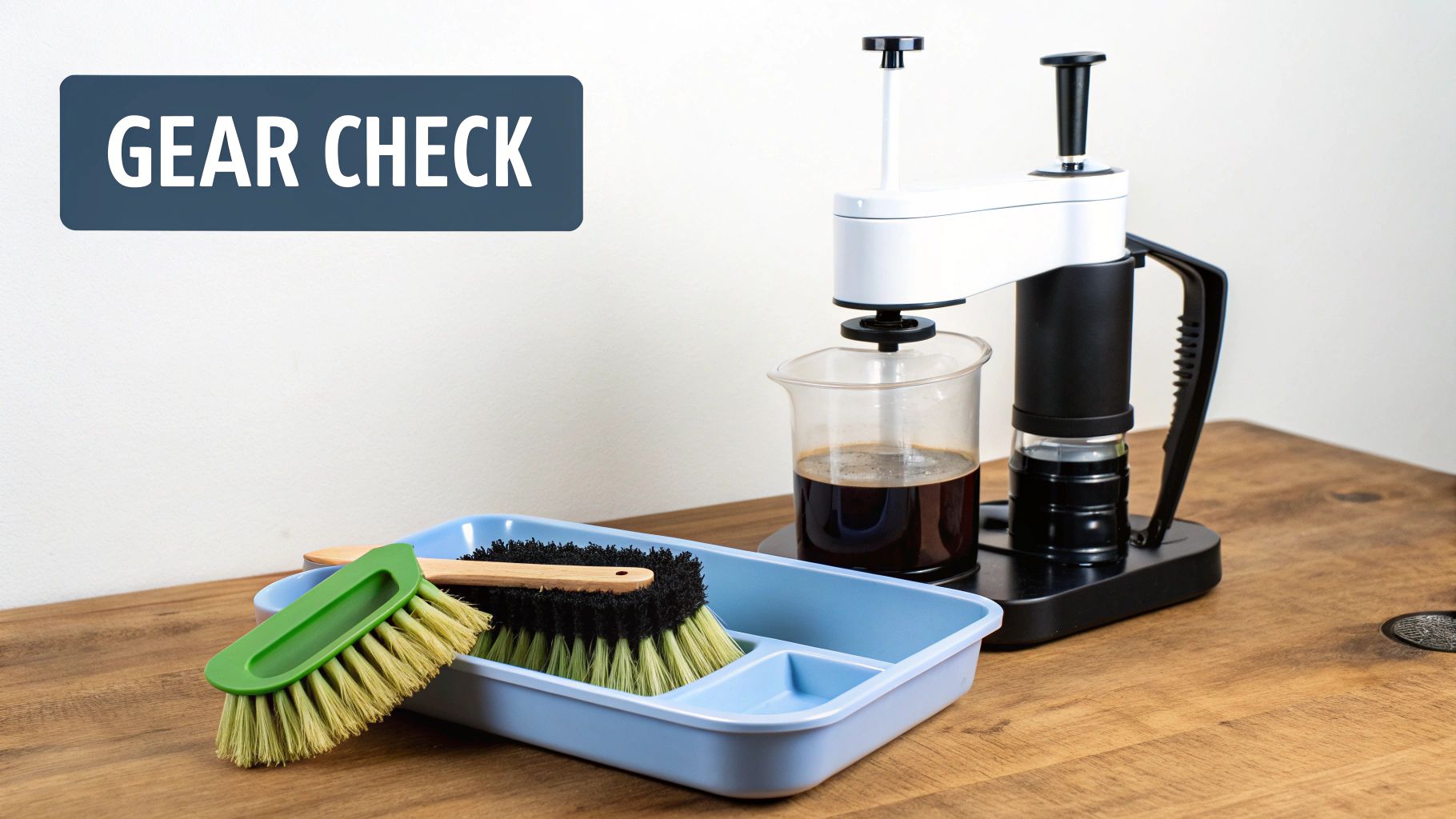
When you let this hardware go, it doesn't just shorten its lifespan—it directly tanks your water quality. A pump gummed up with algae loses its punch, creating dead spots where detritus piles up. A protein skimmer that's out of whack leaves a soup of dissolved organics in the water, which is basically an open invitation for an algae farm to move in.
This isn't just about cleaning; it's about performance.
Mastering Your Protein Skimmer
Think of your protein skimmer as the hardest-working piece of filtration you own. It pulls organic gunk out of the water before it has a chance to rot into nitrates and phosphates. For it to do that job well, it needs to be clean and tuned in.
- Weekly Cup Cleaning: At the very least, you need to empty and rinse that collection cup once a week. If you let that nasty sludge build up, the skimmer's efficiency plummets, and the neck gets so caked with grime that the foam can't even rise properly.
- Monthly Deep Clean: Once a month, it's time to take the whole thing apart. Give the body, the bubble plate, and—most importantly—the pump's venturi valve a thorough cleaning. That tiny little part is notorious for getting clogged with salt creep, which kills your air intake and bubble production.
A well-tuned skimmer should be pulling a consistent, dark, foul-smelling liquid we call skimmate. If what you're getting is watery and light-colored, you're just pulling out saltwater. If it’s barely producing anything, it's not pulling enough waste. You have to play with the water level inside the skimmer body until you hit that sweet spot.
Pumps, Powerheads, and Flow
Good, consistent water movement is non-negotiable in a reef tank. It's what brings food to your corals and whisks their waste away, all while helping with gas exchange at the surface. Over time, though, coralline algae, sponges, and all sorts of other life will start to encrust your powerheads and return pumps, choking off their output.
A quarterly deep clean is the only way to get them back to their factory-spec performance. Just take the pump completely apart and let all the pieces soak in a 50/50 solution of plain white vinegar and RODI water for a few hours. This vinegar bath will dissolve all that stubborn calcium-based coralline algae without harming the pump. Grab a small brush to scrub off anything left over before you put it back together. Trust me, you'll be shocked at how much flow you were missing.
Your Sump and Refugium
The sump is the engine room for your whole setup, where most of your critical gear lives. Keeping it clean and organized is just common sense. Filtration systems are the true unsung heroes of saltwater tank maintenance. It’s no surprise that poor water quality is a leading cause of fish and coral loss, driving hobbyists to constantly seek out better filtration tech.
For those of us running a refugium, managing your macroalgae (usually Chaetomorpha) is a fantastic form of natural nutrient export. As the chaeto grows, it sucks up nitrates and phosphates from the water. You'll want to harvest about one-third to one-half of the chaeto ball every couple of weeks to physically pull those locked-up nutrients out of your system for good. If you want to dive deeper into the nuts and bolts of this critical area, we've got a complete guide on setting up a saltwater sump made simple.
An Effective Strategy for Water Changes and Algae Control
Two of the most hands-on tasks in this hobby are without a doubt managing water changes and battling nuisance algae. They’re also deeply connected. Think of a consistent water change schedule as your best defense against algae, while a smart algae control plan makes those water changes more effective and maybe even less frequent.
Getting both right is how you create that stable, clean environment where your corals and fish can truly flourish.

This process isn't just about diluting the bad stuff like nitrates and phosphates. It’s a hard reset for your tank's chemistry. You're physically pulling out the dissolved organic compounds that fuel algae and, at the same time, putting back the essential trace elements your corals are constantly consuming. Nailing this rhythm makes all the difference.
Perfecting Your Water Change Process
Efficiency is the name of the game here. You want water changes to be a quick, painless part of your routine, not some all-day project you dread. The secret? Prepare high-quality saltwater at least a day in advance.
Always, always start with RODI (Reverse Osmosis Deionization) water. Honestly, using tap water is one of the biggest rookie mistakes you can make. It’s loaded with phosphates, silicates, and other junk that is pure rocket fuel for algae.
Get a clean, dedicated bucket, mix in your favorite salt brand, and drop in a small powerhead and a heater. Let that mix for at least a few hours—ideally overnight—to make sure the salt is fully dissolved and the temperature and salinity are a perfect match for your display tank.
When it's time to swap the water, make it count. Your water change should have a dual purpose: removing old water and cleaning up detritus. Use your siphon to get into those low-flow spots around the rockwork and on the sandbed. That’s where fish waste and uneaten food settle and break down. By physically removing that gunk, you're exporting nutrients before they ever have a chance to cause problems.
A 10% weekly swap is the classic advice for a reason—it mimics the ocean's natural dilution process and keeps things stable. Hobbyists who stick to consistent changes almost always see better coral growth because they're keeping those nitrate levels in check. And remember, using purified RO/DI water is non-negotiable for preventing unwanted contaminants.
A Multi-Pronged Approach to Algae Control
Seeing a sudden bloom of green hair algae or a patch of red cyano is frustrating, I get it. But it’s just your tank’s way of telling you that something is out of balance. Just scrubbing it away is a band-aid fix; you have to get to the root cause, which is almost always excess nutrients.
A truly successful algae control strategy means you have to attack the problem from a few different angles.
- Manage Nutrient Input: This is number one. Overfeeding is the biggest culprit behind excess nitrates and phosphates. Feed your fish only what they can devour in a minute or two. A great pro-tip is to rinse your frozen foods before feeding to wash away the nutrient-rich packing juices.
- Optimize Your Flow: Algae absolutely loves to grow in "dead spots" where the water flow is weak. Take a look at your tank and see where detritus settles. Often, just adding or redirecting a powerhead can eliminate these problem areas, keeping waste suspended so your filter can grab it.
- Assemble the Right Clean-Up Crew: A well-chosen team of invertebrates is absolutely essential. Don't just toss in a random handful of snails. Do a little research on which species are best for the type of algae you're seeing. For example, Trochus snails are champs at cleaning rocks and glass, while Cerith snails are fantastic for sifting the sandbed.
For a deeper dive into specific strategies, our practical guide to saltwater algae control has you covered.
By combining these proactive measures, you create an ecosystem where algae simply doesn't have the fuel to get a foothold. This approach turns a reactive chore into a proactive strategy for a healthier, more beautiful aquarium.
Cultivating a Living Ecosystem with Copepods
Truly next-level reef keeping is about more than just chasing perfect numbers on a test kit. It’s about shifting your mindset from janitor to ecosystem architect. We spend so much time focusing on what to remove—nitrates, phosphates, algae—that we forget to think about what we can add to build a vibrant, living food web.
This is where live nutrition, specifically copepods and phytoplankton, completely changes the game.
When you seed your aquarium with a diverse population of live copepods, you're not just offering a one-off meal. You are laying the foundation for a resident microfauna population. This tiny army becomes a non-stop, natural buffet for your fish and corals, which is absolutely critical for picky eaters like Mandarin Dragonets or Pipefish that often perish without a live food source.
Seeding Your Tank for Long-Term Success
The goal isn't just to feed your tank for a day; it's to establish a thriving, reproducing colony of pods. A little strategy goes a long way here. The best time to add copepods is after your lights have gone out for the night. This darkness gives them cover to scurry into the rockwork and sandbed, safely away from the prying eyes of hungry fish.
When you’re ready to add them, turn off your pumps and skimmer for about 30-60 minutes. Pour the bottle right into the display tank. This brief downtime lets the tiny crustaceans settle and find refuge in all the nooks and crannies of your live rock. Seeding your refugium at the same time is a fantastic move, as it creates a protected "nursery" where the pod population can boom without being eaten.
Fueling the Food Web with Phytoplankton
Of course, your new copepod workforce needs to eat, too. That's where phytoplankton enters the picture. Dosing live phytoplankton is like adding fertilizer to the very base of your aquarium’s food chain. These microscopic algae are the primary food source for copepods, and adding them regularly is what will make your pod population explode.
The benefits don't stop there. Many of your corals—especially softies and gorgonians—are filter feeders that will directly consume phytoplankton right out of the water column. You'll often see better polyp extension and richer coloration as a direct result of regular dosing.
Think of it this way: copepods are the clean-up crew and live food source, while phytoplankton is the fuel that powers the entire system. By adding both, you create a complete and self-reinforcing nutritional loop within your aquarium.
For reefers who love a good DIY project, creating a sustainable supply is totally achievable. You can dive into guides on how to culture copepods at home. It's a rewarding side-hustle that ensures you’ve always got the freshest live food on deck.
Integrating PodDrop products into your routine is straightforward. The key is to match the dosing strategy to your specific goals, whether you're trying to establish a new pod population, feed hungry fish, or just boost your tank's overall biodiversity.
PodDrop Live Nutrition Seeding and Feeding Guide
Here's a simple breakdown for using our live copepods and phytoplankton to meet different tank goals.
| Goal | Recommended PodDrop Product | Dosing Instructions | Key Benefit |
|---|---|---|---|
| Establish a New Pod Population | Galaxy Pods or OceanMagik Phyto | Add the entire bottle at night with pumps off for 30-60 mins. Dose phyto 2-3 times/week. | Creates a self-sustaining food source, reducing long-term feeding costs. |
| Feed Picky Eaters (Mandarins) | Ecopods or a blend of Galaxy Pods & Apex-Pods | Add 1/2 to 1 full bottle directly to the display tank 1-2 times per week at night. | Provides a continuous supply of the right-sized pods to keep demanding fish healthy. |
| Boost Coral Color & Health | OceanMagik Phyto & Galaxy Pods | Dose phyto 3-4 times/week. Add a bottle of pods once every 2 weeks. | Delivers essential fatty acids and nutrients for vibrant color and polyp extension. |
| Natural Algae & Detritus Control | Ecopods or Galaxy Pods | Seed the tank initially, then add a "booster" bottle once a month. | Populates the tank with micro-janitors that graze on film algae and waste. |
This table serves as a starting point. Every tank is different, so observe your inhabitants' reactions and adjust your dosing schedule to find what works best for your unique ecosystem.
Pods as a Proactive Maintenance Crew
Beyond just being fish food, copepods are a vital part of your saltwater tank maintenance team. They are relentless consumers of detritus, ugly film algae, and diatoms. A healthy pod population works 24/7 as a microscopic janitorial service, constantly grazing on waste in places your siphon and scraper could never dream of reaching.
This is proactive nutrient control. You aren't just reacting to an algae outbreak; you're actively preventing it by having a crew that outcompetes it for resources. Over time, cultivating this living ecosystem means less hands-on cleaning for you and a more stable, resilient, and fascinating aquarium. Seeing the subtle scurry of pods across the glass and rocks is the ultimate sign of a truly healthy, mature system—and that’s the goal every dedicated reefer is chasing.
No matter how dialed in your maintenance routine is, every reefer eventually has that moment of panic. You walk by your tank, and something is just… off. A sudden algae outbreak, your favorite chalice is closed up tight, or a fish is acting weird. These moments are part of the hobby, but they don't have to be disasters.
Instead of panicking, think of it as your tank trying to tell you something. Learning to read the signs and react methodically is a skill that will make you a much more confident aquarist. The key is to take a breath, observe, and run through a mental checklist before you do anything drastic.
Decoding a Sudden Algae Bloom
Waking up to a green, brown, or red mess covering your rocks is demoralizing. But before you grab the toothbrush and start scrubbing, you need to play detective. Different types of algae are symptoms of different root problems, and just manually removing them without fixing the source is a battle you will never win.
- Green Hair Algae (GHA): This is the classic sign of high nitrates (NO₃) and phosphates (PO₄). It’s your tank's way of telling you you're either overfeeding, your skimmer or refugium isn't pulling its weight, or you've slacked on water changes.
- Brown Diatoms: Super common in new tanks, diatoms feed on silicates. If you see this bloom in a mature tank, it's a huge red flag that your RODI water filter cartridges are shot. They're no longer stripping out silicates, and you're just adding fuel to the fire with every top-off.
- Red Slime (Cyano): This stuff isn't even true algae; it's a photosynthetic bacteria. Cyano loves low-flow areas and is fueled by dissolved organic compounds. It’s a dead giveaway that detritus is piling up in dead spots. You likely need to aim a powerhead differently or add more to your cleanup crew.
The very first thing to do is test your nitrates and phosphates. Then, think back on the last week. Did you add a new fish? Get a little heavy-handed with the frozen mysis? Pinpointing where the nutrients are coming from is how you win the war.
Why Are My Corals SULKING?
A coral that’s closed up is sending a clear signal: it’s stressed. Since corals are stuck in one spot, pulling in their polyps is their main defense when things go sideways. A quick diagnostic check will usually get you to the bottom of it.
Start with the usual suspects. Grab your refractometer and alkalinity test kit. A swing in salinity or alk is, nine times out of ten, the reason for unhappy corals. Even a small salinity dip from a wonky auto top-off is enough to make them clam up.
If your chemistry is solid, look at the physical environment.
A coral that was happy yesterday and is closed today is reacting to something that just changed. Don't reach for a bottle of magic potion. Look for the simple stuff first. Did a powerhead get bumped and is now blasting it? Did a clumsy hermit crab or snail crawl all over it? You'd be surprised how often it's something that simple.
Also, get in there and look for pests. Inspect the coral closely, especially around the base, for things like flatworms or nudibranchs. Sometimes the problem isn't in the water at all, but a nasty hitchhiker that decided to make your prized coral its lunch.
Reading the Signs: Fish Stress and Equipment Failure
Your fish are like little windows into the health of your tank. Early signs of stress can be subtle—breathing a little too fast, hiding more than usual, or slightly tattered fins. These symptoms could point to poor water quality, bullying from a tank mate, or the beginning of an illness like ich. Watching your fish for five minutes every day makes it incredibly easy to spot when someone's behavior is off.
Then there's the gear. An equipment emergency, like a failed return pump or a stuck-on heater, demands you act immediately. A silent tank is often the first sign of a pump failure, which means filtration and gas exchange just stopped. A heater that's stuck on can cook a tank in hours, and it's almost always fatal. This is exactly why a reliable digital temperature controller with a failsafe is one of the best investments you can make for your reef's safety.
At PodDrop, we believe a healthy, balanced ecosystem is the ultimate defense against common tank problems. By seeding your reef with our live copepods and phytoplankton, you’re establishing a natural food web and a microscopic cleanup crew that works 24/7 to outcompete nuisance algae for nutrients. Build a more resilient and vibrant reef at https://www.getpoddrop.com.