

Large Reef Aquariums: The Essential Guide to Planning and Setup
So, you’re thinking about going big. Really big.
There's nothing quite like the jaw-dropping beauty of a massive reef aquarium. These aren't just fish tanks; they're living, breathing ecosystems that represent the peak of what's possible in this hobby. But let me be straight with you: success on this scale is born from serious planning, a significant budget, and accepting that you're an engineer of a complete life support system.
Embarking on Your Grand Underwater Vision
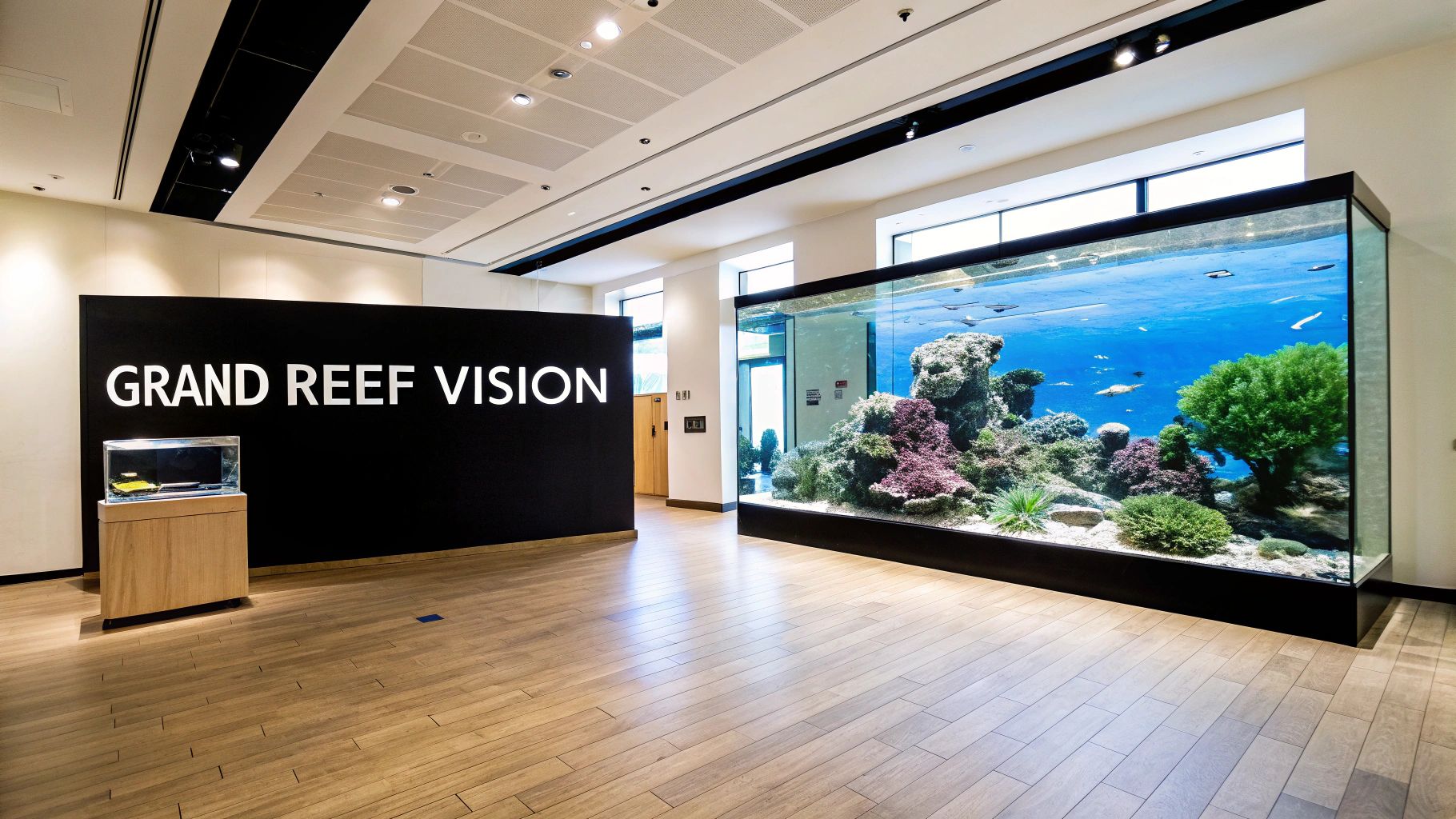
Jumping into the world of large reef aquariums—I’m talking systems over 200 gallons—is a journey that’s part art, part science, and a whole lot of commitment. These grand displays operate on a completely different level than their smaller cousins. The margin for error shrinks dramatically as the water volume, equipment complexity, and financial investment all skyrocket.
This guide is your foundational briefing. We're skipping the fluff to get straight to the real-world challenges and incredible rewards of keeping a large-scale reef. Success isn't about just buying the biggest tank you can find. It's about adopting a mindset of precision, patience, and proactive management from day one.
The Amplified Demands of Scale
The core principles of reef keeping don't change, but how you apply them gets amplified exponentially in a big system. A trick that works for a 75-gallon tank often falls flat or becomes wildly impractical for a 300-gallon setup.
And it’s clear this fascination with going big is catching on. The global reef aquarium market hit an incredible USD 4,892.2 million in 2020 and is projected to surge to USD 11,020.5 million by 2028. That's a powerful signal that the passion for these monster tanks is growing. You can dig into more of the data on these market trends to see what’s driving this growth.
To really put this into perspective, let’s look at what separates a standard reef from a large one.
The biggest mental shift you'll make when moving to a large reef aquarium is going from reactive problem-solving to proactive system management. You have to anticipate problems and build in redundancy, because fixing an issue in 400 gallons of water is a whole different beast than in 40.
The demands on your equipment, your time, and your wallet scale up significantly. The table below gives you a quick snapshot of just how different the game is when you level up. This isn't meant to scare you off, but to show why meticulous planning isn't just a good idea—it's absolutely essential.
Standard vs. Large Reef Aquarium Demands at a Glance
| System Aspect | Standard Reef (Under 100 Gallons) | Large Reef (200+ Gallons) |
|---|---|---|
| Water Chemistry | Manageable with routine water changes and simple dosing. Small fluctuations are common. | Requires automated dosing, calcium reactors, and precision monitoring. Stability is non-negotiable. |
| Filtration | Hang-on-back skimmers, canister filters, or small sumps are often sufficient. | Demands a large, well-designed sump, oversized protein skimmer, and often a refugium or algae reactor. |
| Equipment Cost | Moderate initial investment. Upgrades are relatively inexpensive. | Significant upfront cost for tank, stand, and life support. High-end equipment is standard. |
| Maintenance | Weekly water changes of 10-20 gallons are typical. Manual cleaning is straightforward. | Water changes are logistical challenges. Requires automated top-off systems and often automated water change systems. |
| Flow & Lighting | A few powerheads and a standard LED fixture usually suffice. | Requires multiple, powerful, controllable pumps and several high-output light fixtures for adequate coverage and intensity. |
| Margin for Error | Small mistakes can often be corrected quickly with a water change. | A small error (e.g., dosing mistake, heater failure) can lead to catastrophic, expensive losses. Redundancy is key. |
As you can see, everything from your daily checks to your long-term budget needs to be re-evaluated. It’s a bigger commitment, but the payoff—a stable, thriving slice of the ocean in your home—is more than worth the effort.
Blueprint for Success: Planning Your Large Reef Tank
Before a single drop of saltwater ever touches the glass, the real work of building a large reef aquarium begins. This is the blueprint phase. It's where you map everything out and get brutally honest about the budget, laying a solid foundation for the incredible ecosystem you're about to create. Cutting corners here is probably the number one reason I've seen ambitious projects stumble.
The very first piece of the puzzle is location, and it's about much more than just finding a spot with a nice view. We're talking about a serious logistical and structural challenge.
A filled 250-gallon aquarium can easily top 3,000 pounds. If you have wood floors, calling a structural engineer isn't just a good idea—it's mandatory. They’ll make sure you place the tank over a load-bearing wall, ideally running perpendicular to the floor joists, to safely spread out that immense weight.
Beyond the sheer weight, you need to think about your daily life with a monster tank. You'll need plenty of elbow room around it for maintenance, cleaning, and tinkering with gear. And don't forget practicalities like how close you are to a water source for water changes and how many outlets you have for the small army of equipment that will keep your reef alive.
Choosing Your Aquarium: Materials and Design
Once you've nailed down the location, it's time to think about the tank itself. For a large reef, the classic glass versus acrylic debate is a major decision point.
- Glass Aquariums: The big win here is scratch resistance and clarity that won’t yellow with age. The trade-off? They are incredibly heavy and more brittle, so an accidental impact can be catastrophic. Most reefers spring for low-iron glass for that extra pop of clarity.
- Acrylic Aquariums: These are significantly lighter—about half the weight of glass—and have much stronger, more forgiving seams. The catch is that they scratch very easily. You'll need to be extra careful and use specialized cleaning tools to keep it looking pristine.
The tank's design also dictates both its look and its functionality. A rimless tank gives you that clean, modern aesthetic but often lacks the structural reinforcement of a euro-braced design. That extra frame around the top provides stability, which is a smart move for seriously big systems. A peninsula-style tank, which you can view from three sides, makes a stunning room divider but demands a lot more thought when it comes to aquascaping and creating proper flow.
Here's a classic rookie mistake: spending the entire initial budget on the display tank. The truth is, the life support system—your sump, skimmer, pumps, and lighting—will often cost just as much, if not more, than the tank and stand.
Crafting a Realistic and Comprehensive Budget
Underestimating the true cost is the Achilles' heel for so many reefers dreaming of a large tank. A real-world budget has to account for every single component, from the day-one purchases to the ongoing monthly bills.
You have to think past the obvious. The sump, for instance, isn't just a bucket to hide gear. A well-thought-out sump will have dedicated chambers for your equipment and, crucially, a refugium for natural nutrient export. If you want to go deeper on that topic, our refugium in sump guide is a complete walkthrough on how to optimize this critical piece of the puzzle for a thriving reef.
Let's put some real numbers to this with an example.
Estimated Budget Breakdown: 250-Gallon System
| Category | Estimated Cost Range | Notes |
|---|---|---|
| Tank, Stand, & Canopy | $3,000 - $7,000+ | This varies wildly based on glass vs. acrylic and any custom work. |
| Life Support System | $2,500 - $6,000 | This is your sump, skimmer, return pump, and heaters. Don't skimp here. |
| Lighting & Flow | $2,000 - $5,000 | High-end LEDs and multiple controllable powerheads are non-negotiable for coral health. |
| Rock, Sand, & Salt | $1,000 - $2,500 | The cost of quality live or dry rock and enough salt for the initial fill and the first few water changes. |
| Initial Livestock | $1,000 - $4,000+ | This is entirely up to you and your dream list of fish and corals. |
| Ongoing Monthly Costs | $100 - $300+ | Think electricity, salt mix, supplements, food, and test kits. |
As you can see, the investment adds up fast. For a 500-gallon system, you can pretty much expect to double these numbers. Taking the time to plan meticulously and budget honestly from the very beginning is what will turn your dream of a massive reef tank into a sustainable and deeply rewarding reality.
Engineering the Ecosystem for a Thriving Reef
The breathtaking display tank you see is really just the tip of the iceberg. Down below, out of sight, lies the true heart of a large reef aquarium—a complex, engineered ecosystem designed to process waste, maintain stability, and mimic the life-giving forces of the ocean. This life support system, almost always housed in a sump, is where the real magic of sustainable reef keeping happens on a grand scale.

Think of your sump as the command center for the entire operation. It's not just a convenient place to hide heaters and skimmers; it's a purpose-built water treatment plant. Nailing the design from the start is absolutely crucial for making sure every piece of equipment works at peak efficiency. When you're planning your sump, a good rule of thumb is to aim for a total volume that's 25-40% of your display tank's volume.
That generous sizing gives you a critical buffer against power outages, helps prevent overflows, and leaves you plenty of room for equipment without creating a cluttered, inefficient mess. A well-designed sump for a big system will have multiple chambers that guide water through a logical filtration sequence—from mechanical filtration to protein skimming and finally to the return pump chamber.
Designing the Sump for Optimal Performance
A logical flow path is everything for a high-performing sump. You want water to first enter a chamber with filter socks or a filter roller to strip out the big stuff. From there, it should flow into the main chamber housing the protein skimmer and any reactors. Finally, it passes through bubble traps into the return chamber, making sure microbubbles don't get blasted back into your display.
- Mechanical Filtration Chamber: This is your first line of defense against detritus and leftover food. Filter socks are a common choice, but they need to be changed out constantly. For large reef aquariums, automated filter rollers are a fantastic upgrade, as they continuously pull waste out of the water column.
- Protein Skimmer and Reactor Chamber: This needs to be your largest section. Critically, it must have a constant water level for your protein skimmer to perform reliably.
- Refugium Chamber: A dedicated spot for macroalgae (like Chaetomorpha) gives you powerful, natural nitrate and phosphate reduction. This chamber needs its own light and does best with slower, gentler flow.
- Return Chamber: This is where your main return pump lives. Its water level will drop as water evaporates, so this is exactly where your auto top-off system's sensor should be placed.
The most overlooked aspect of sump design is accessibility. Make sure you can easily reach every single piece of equipment for routine maintenance. A skimmer that’s a nightmare to remove for cleaning will inevitably get neglected, and that will compromise your entire system's health.
Feeling a bit overwhelmed by the plumbing and chamber layout? It can be a lot to take in. For those just starting out, our guide on setting up a saltwater sump made simple offers a clear, step-by-step approach to get you on the right track.
The Power of Protein Skimming and Filtration
For a large reef tank with a heavy bioload, a powerful, oversized protein skimmer isn't a luxury—it's an absolute necessity. A skimmer's job is to pull dissolved organic compounds out of the water before they can break down into nitrates and phosphates. For a 300-gallon tank, you should seriously be looking at a skimmer rated for 400-500 gallons to give yourself a solid margin of safety.
Modern filtration philosophies often blend aggressive skimming with natural methods. While the classic "Berlin Method" relied almost entirely on live rock and a good skimmer, many of the most successful large reefs today also incorporate huge refugiums or algae reactors. This creates a more balanced system, using technology to export waste while cultivating a natural engine for nutrient consumption.
If you want to see large-scale water processing, just look at public aquariums. The Chimelong Spaceship in China holds a staggering 56,450,136-liter main tank. Its massive filtration systems recycle millions of liters every single day. Learning about these colossal underwater worlds and their engineering marvels really puts the principles of large-scale water management into perspective.
Mastering Water Movement Across a Vast Landscape
In a big tank, creating effective water movement is way more complex than just tossing in a few powerheads. The goal is to generate strong, randomized, and wide-ranging flow that feeds corals, keeps detritus suspended for filtration, and kills any stagnant "dead spots" where waste can settle and rot.
To pull this off, you need a multi-pump strategy. A combination of different pump types almost always gives the best results.
- Controllable DC Pumps: These are perfect as return pumps, letting you dial in the exact flow rate through your sump. They're also the powerhouse behind closed-loop systems—dedicated plumbing loops that pull water from the display and shoot it back in to create massive flow without taxing the sump.
- Wavemakers and Gyre Pumps: These are your in-tank workhorses. Wavemakers create that pulsing, wave-like motion, while gyre pumps generate a wide, sheet-like flow that moves huge volumes of water from one side of the tank to the other.
A smart setup for a 6-foot, 240-gallon tank might involve two gyre pumps on either end running in an anti-sync mode. You could then complement them with one or two smaller, controllable wavemakers aimed at specific zones within your rockwork. This creates a chaotic, constantly shifting current that closely mimics a natural reef, ensuring every single coral gets the flow it needs to truly thrive.
Mastering Light and Chemistry at Scale
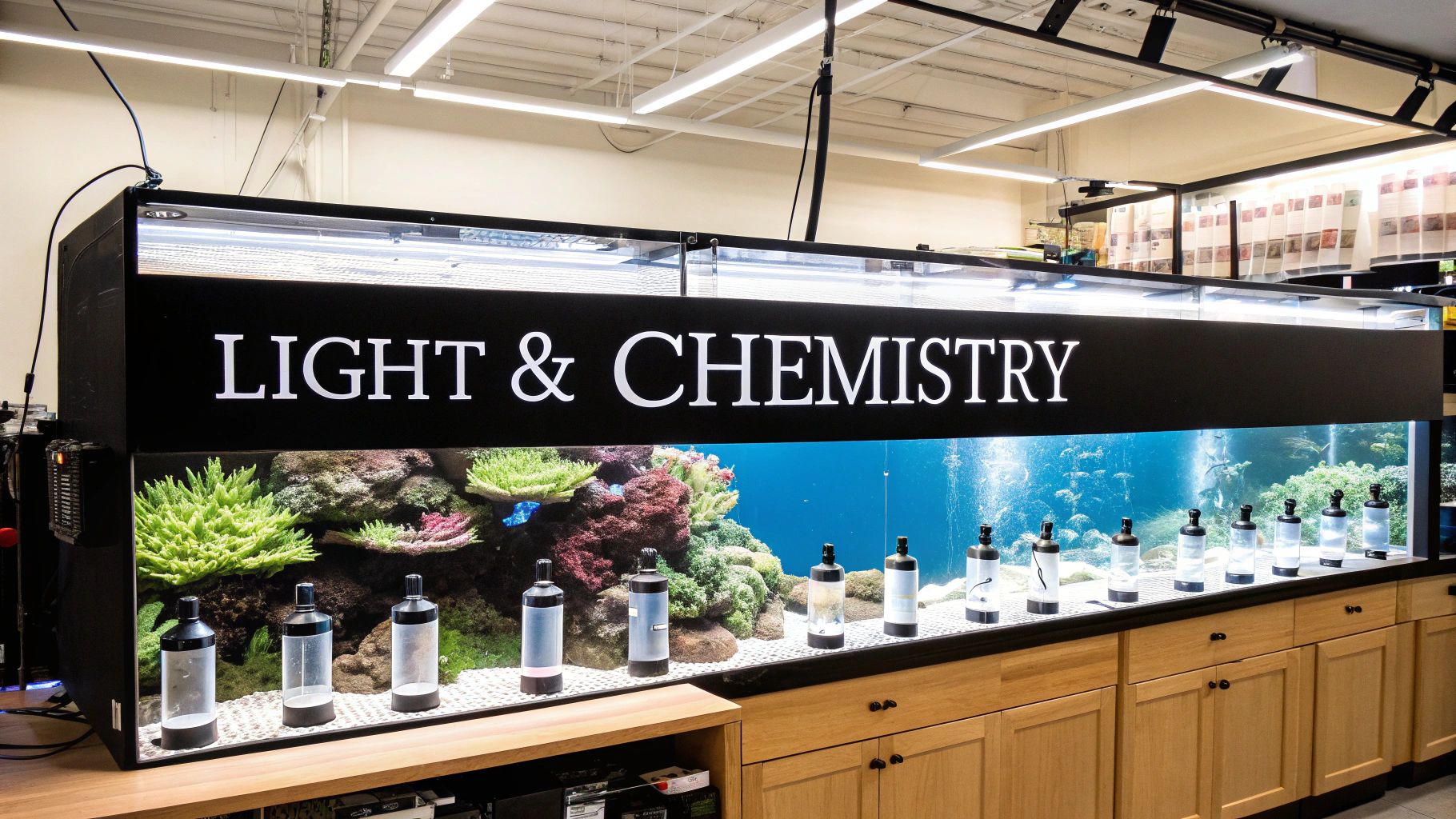
In a big reef system, your lighting and water chemistry are the twin engines that drive everything. Getting them right isn't just a matter of adding more gear or dumping in more chemicals; it’s about dialing in precision and stability across a massive volume of water. The truth is, as your tank gets bigger, your margin for error gets smaller. The old hands-on methods that worked on your 75-gallon tank just won't cut it here.
Nailing these two elements is what separates a pretty good large reef from a truly breathtaking one. It forces a mental shift—away from daily manual tweaks and towards automated, reliable control. You have to develop a much deeper feel for how light energy and chemical parameters dance together in a huge aquatic world.
Illuminating a Grand Underwater Landscape
Lighting a big tank is a game of coverage and intensity. You can't just slap on more fixtures and call it a day. The real puzzle is delivering consistent, high-quality light from corner to corner and top to bottom. You're fighting to eliminate shadows and ensure every coral, whether it's at the surface or deep in a crevice, gets the energy it needs to pop.
This is where you absolutely have to understand Photosynthetically Active Radiation (PAR). PAR is the real-world measure of usable light energy for your corals. In a large mixed reef, you might be shooting for PAR values of 150-250 down low for your LPS, while the SPS corals up top could be begging for 350-500+ PAR. Hitting those numbers consistently across the board comes down to smart tech choices and placement.
- LED Fixtures: This is the modern standard, hands down. You get insane control over spectrum and intensity. For a large tank, this means banks of high-end fixtures, often mounted on a track system to get that perfect, even spread and avoid torching anything with "hot spots."
- T5 Hybrids: A fantastic choice for big tanks. These fixtures blend LED pucks with T5 fluorescent bulbs. You get the shimmer and control of LEDs with the beautiful, shadow-killing blanket coverage of T5s. They're a dream for dense SPS colonies.
- Metal Halides: You don't see them as much these days because of the heat and power draw, but don't count them out. Halides are still champs at punching light deep into the water column, making them a solid option for exceptionally deep reef aquariums.
So many reefers make the mistake of only measuring PAR directly under a light. On a large system, the numbers you get in the corners and between the fixtures are just as critical. Get a PAR meter, map out the entire tank, and start adjusting your fixture height and layout until you've created a balanced, consistent field of light.
Achieving Chemical Stability at Scale
When it comes to water chemistry in a large reef, the name of the game is stability, not chasing some "perfect" number. That huge water volume is a fantastic buffer against sudden swings, but it also means the daily consumption of Alkalinity, Calcium, and Magnesium by hundreds of corals is absolutely massive. Trying to keep up with manual dosing is a recipe for frustration and failure. It’s just not sustainable.
This is the point where automated systems go from being a luxury to a complete necessity. They are the only realistic way to maintain the rock-solid parameters that demanding corals need to truly thrive.
- Automated Dosing Pumps: This is the go-to solution for most. These pumps deliver precise, tiny amounts of your liquid supplements all day long. For a big system, you'll want to invest in large-volume dosing containers so you aren't refilling them every few days.
- Calcium Reactors: For a mature, SPS-heavy tank, a calcium reactor is a game-changer. It's the ultimate "set it and forget it" solution. The reactor uses CO2 to slowly dissolve aragonite media, which constantly releases balanced levels of calcium and alkalinity—mimicking the natural process on a real reef.
Your testing schedule needs to be almost religious at first, especially while you're figuring out your tank's appetite. Once things are stable, you can ease up a bit, but that initial phase is crucial for learning your system's unique consumption rates.
Recommended Water Chemistry Testing Schedule
| Parameter | Frequency (New System) | Frequency (Stable System) | Target Range |
|---|---|---|---|
| Alkalinity (dKH) | Daily | 2-3 times per week | 8.0 - 11.0 dKH |
| Calcium (Ca) | Every 2-3 days | Weekly | 400 - 450 ppm |
| Magnesium (Mg) | Weekly | Every 1-2 weeks | 1250 - 1350 ppm |
| Nitrate (NO3) | Weekly | Weekly | 2 - 10 ppm |
| Phosphate (PO4) | Weekly | Weekly | 0.03 - 0.10 ppm |
Nutrients like nitrates and phosphates require a constant balancing act. In a heavily stocked system, your protein skimmer and refugium are doing the heavy lifting. Still, knowing how to manage these levels is what keeps nuisance algae at bay and corals healthy. For a deeper dive, our complete guide to nitrate removal from aquarium ecosystems offers practical advice you can use on any size system. Mastering this is fundamental to your long-term success.
A Smart Approach to Stocking Your Reef
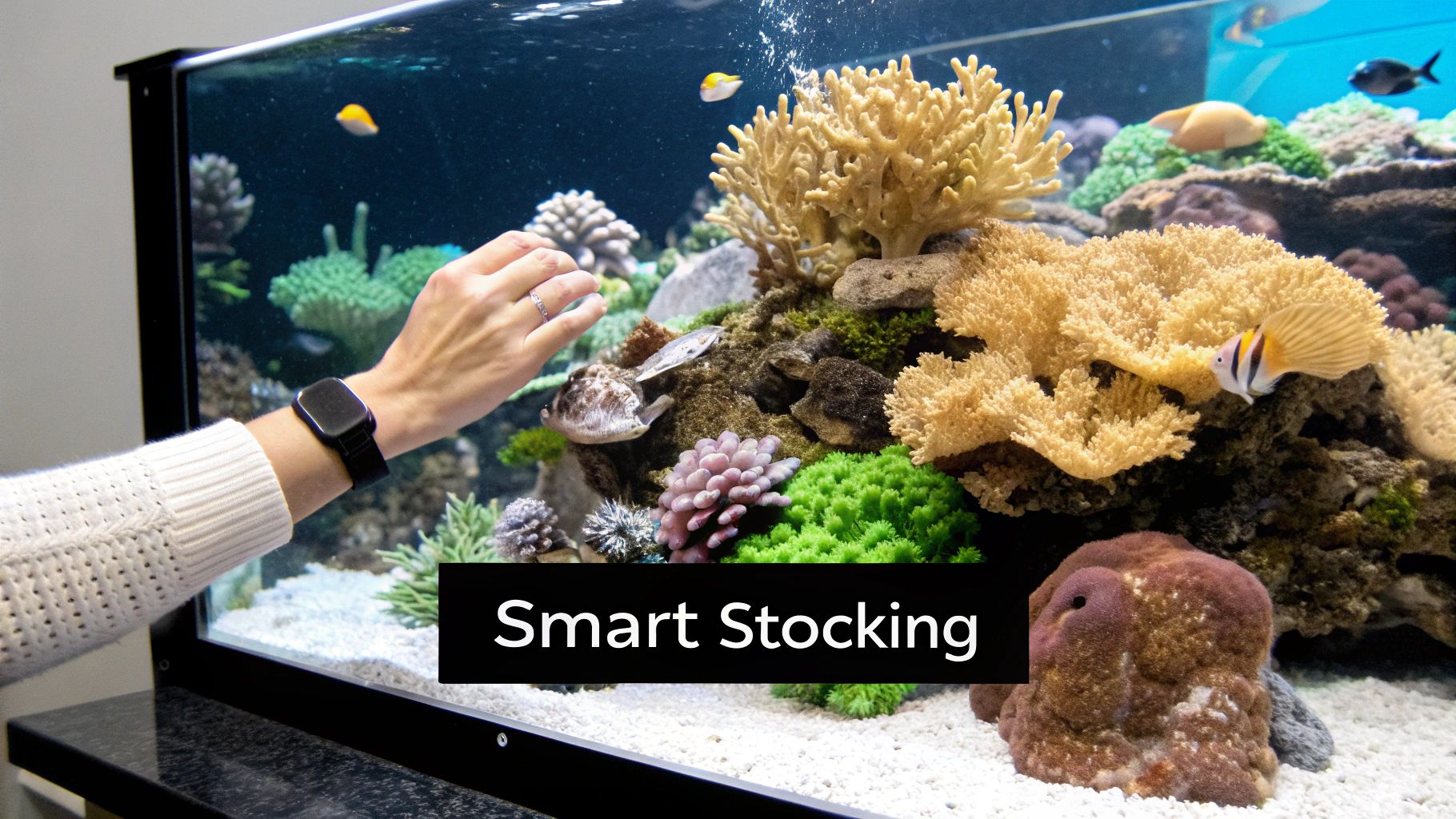
Okay, your life support is humming along nicely and the water parameters are locked in. Now comes the best part—finally bringing this world you’ve engineered to life. But stocking a big reef tank is an art form. It’s a delicate dance of patience, smart compatibility choices, and a real respect for the unseen critters that make the whole system tick.
I’ve seen it a hundred times: rushing this process is the quickest way to invite total chaos and disease into a perfectly stable environment. Every single fish, coral, or invert you add is a potential Trojan horse for nasty parasites like Ich or Velvet.
That's why a strict quarantine (QT) protocol isn't just a friendly suggestion; it's the single most important thing you can do to protect your massive investment. You absolutely need a separate, established quarantine tank to observe and treat any new arrivals for at least four to six weeks before they even think about touching your display water. No exceptions.
Designing a Balanced Fish Community
The sheer volume of a large aquarium opens up some incredible possibilities for a diverse fish community, but it's not a free pass to just add whatever catches your eye. The core rules of compatibility—temperament, diet, and full-grown adult size—are more critical than ever. A territorial dispute that's just a minor squabble in a 75-gallon tank can turn into a lethal war in a 300-gallon system where a bully has more ground to claim.
Your whole stocking plan should be built around the type of reef you're creating. An SPS-dominant tank, for example, really calls for peaceful, reef-safe herbivores. A predator tank, on the other hand, demands a careful selection of robust, equally-matched carnivores.
Here are a few stocking ideas to get you started:
- The Classic Mixed Reef (300+ Gallons): This approach is all about creating color and movement at every level. Think big schools of Anthias, a stunning showpiece angelfish like a Regal or Emperor, a few different tang species (Yellow, Kole, Powder Blue), and a variety of wrasses to add activity and help with pest control.
- The SPS-Dominant System (250+ Gallons): Here, you have to prioritize fish that won't even think about nipping at delicate coral polyps. Large schools of Green Chromis or Blue/Green Reef Chromis look incredible. Complement them with a "cleanup crew" of tangs and smaller fish like flasher wrasses and gobies that dart around the rockwork.
- The Large Predator Tank (400+ Gallons): This one is for hobbyists who love fish with big personalities. A Volitans Lionfish, a Miniatus Grouper, and a large Tuskfish can actually coexist if you introduce them correctly and give them tons of rockwork and places to hide. Just remember, this kind of tank is generally a no-go for most corals.
The logistics of a truly massive system are mind-boggling. When Australia's Reef HQ—once the world's largest living coral reef aquarium—went through a redevelopment, the staff had to pull off a "Noah's Ark" operation. They relocated 5.5 tonnes of reef rock, sand, and livestock. It’s a powerful reminder of the immense scale of large reef aquariums, where even the rockwork weighs tons. You can read more about this ambitious aquatic relocation effort and its challenges.
Cultivating the Unseen Food Web
Fish and corals might get all the attention, but the true foundation of a resilient reef is its microfauna. A thriving population of copepods and amphipods is a game-changer. It provides a constant, natural food source for picky eaters and does a fantastic job processing detritus. In a large system, you need to be proactive about seeding and sustaining this population.
Start by adding multiple species of live copepods, like Tisbe and Tigriopus, directly to your sump and display tank. These tiny crustaceans are incredibly resilient and will quickly set up shop in your rockwork and sandbed, creating a self-generating food supply.
To really kick this micro-ecosystem into high gear, start dosing live phytoplankton on a regular basis. Think of it this way: phytoplankton isn't just for feeding corals directly. It's the very base of the marine food web. It nourishes your copepod populations, ensuring they stay dense and reproduce like crazy. This simple step creates a far more natural and stable environment where sensitive species like Mandarin Dragonets don't just survive—they thrive, constantly grazing on the abundant life hidden right in the rocks.
Got Questions About Big Reef Tanks? We've Got Answers.
Stepping up to a large reef aquarium is exciting, but it’s natural to have some big questions swirling around. Moving from daydreaming about a wall-sized tank to actually setting one up means grappling with real-world challenges—from whether your floor will collapse to what the real monthly costs look like. Let's tackle the most common (and most critical) questions I hear from hobbyists making the leap.
"Will My Floor Actually Hold This Thing?"
This isn't just a question; it's the question you have to answer before a single drop of water enters your home. The sheer weight of a large reef system is staggering. A 250-gallon setup, once you factor in the tank, water, stand, live rock, and sump, can easily top 3,000 pounds. Your average residential floor isn't built for that kind of concentrated load.
Seriously, don't guess on this one. Here’s the breakdown:
- On a Concrete Slab? You're Golden. If your tank is destined for a basement or a ground floor built on a concrete slab, you can pretty much relax. These foundations are more than capable of handling the weight.
- On a Wood-Joist Floor? Call a Pro. For any floor supported by wooden joists—think upper levels or homes with a crawlspace—you absolutely must consult a structural engineer. This is not optional. They’ll come out and assess the joist size, spacing, and span to give you a definitive answer on the floor's load capacity.
To give yourself the best shot, always plan to place the tank against a load-bearing wall, running perpendicular to the floor joists to spread the weight across as many as possible. It's very common for an engineer to recommend adding a few support columns in the basement or crawlspace directly under the tank's footprint. Think of it as the best insurance policy you'll ever buy for your home and your peace of mind.
"What Are the Real Hidden Costs Here?"
The initial sticker shock of the tank and equipment is one thing, but it's the recurring, operational costs that blindside most people. The undisputed king of hidden costs is electricity. Those powerful return pumps, multiple heaters, high-intensity lights running 8-10 hours a day, and maybe even a chiller… they all add up to a noticeable spike in your monthly utility bill.
The next biggest hit to the wallet is consumables. For a 300-gallon tank, even a small 10% water change means you're mixing up 30 gallons of saltwater at a time. That's a lot of salt mix over a year. Your automated doser will also be flying through alkalinity, calcium, and magnesium supplements at a rate you've never seen before. And don't forget the cost of high-quality frozen foods for a larger community of fish, or replacement parts like pump impellers and RO/DI filters.
Here's a pro tip for budgeting: Calculate what you think your ongoing monthly costs will be, then tack on an extra 20-30%. That buffer will comfortably absorb the true cost of consumables and any unexpected expenses that pop up, saving you a ton of stress.
"How on Earth Do You Clean a Tank That Big?"
Maintaining a massive tank is all about having the right tools and a streamlined process. Forget about lugging buckets of water around—that's just not going to happen.
- Water Changes: A dedicated water mixing station is non-negotiable. This usually means setting up one or two large brute trash cans, a powerful mixing pump, a heater, and plenty of vinyl tubing to pump water directly to and from the tank. No more spills, no more back pain.
- Cleaning Tools: You'll need a good, long-handled algae scraper with interchangeable blades for glass or acrylic. For substrate cleaning, a gravel vacuum with an extra-long hose that can reach a nearby sink or drain makes the job manageable instead of a nightmare.
- The Routine: The tasks are the same—testing water, scraping the glass, emptying the skimmer—but the scale is different. That huge protein skimmer might fill its collection cup every couple of days instead of weekly. You'll also be refilling those dosing containers far more frequently than you're used to.
The key is to break your maintenance into a simple daily, weekly, and monthly schedule. Quick daily checks on equipment, a weekly glass cleaning session, and a monthly deep clean of your pumps will keep the work from piling up into an overwhelming chore.
"What's Most Likely to Fail on a Large System?"
With big tanks, the most devastating failures almost always come down to two things: plumbing or temperature control.
A single cracked PVC fitting, a leaky union, or a failed bulkhead can unleash hundreds of gallons of saltwater onto your floor, causing catastrophic property damage. Don't cheap out here. Use high-quality PVC cement, double-check every connection, and install gate or ball valves on every piece of equipment. This allows you to isolate a single pump or reactor for maintenance without having to shut down your entire system.
The other major point of failure is temperature. A heater that gets stuck in the "on" position can cook your entire tank in a matter of hours. A chiller that fails during a summer heatwave can be just as deadly. The absolute best defense is a reliable, external temperature controller. These devices use their own independent probe to monitor the water temperature and will cut power to your heaters or chiller if they malfunction, stopping a disaster before it ever starts.
At PodDrop Live Aquarium Nutrition, we know that a truly thriving reef is built on a vibrant, living food web. Give your large aquarium the foundation it needs with our fresh, live copepods and phytoplankton, supporting everything from your most demanding corals to your most delicate fish.
Explore our live nutrition options and see the difference a living ecosystem makes.